
Self-Levelling Compound
Specification-grade self-levelling compound in Accra — the verified-flat substrate underlay beneath marble, polished concrete, hardwood and ESD floors, with ASTM E1155 F-number verification and ASTM F2170 slab moisture testing before any premium finish is committed. Floors GH, since 1972.
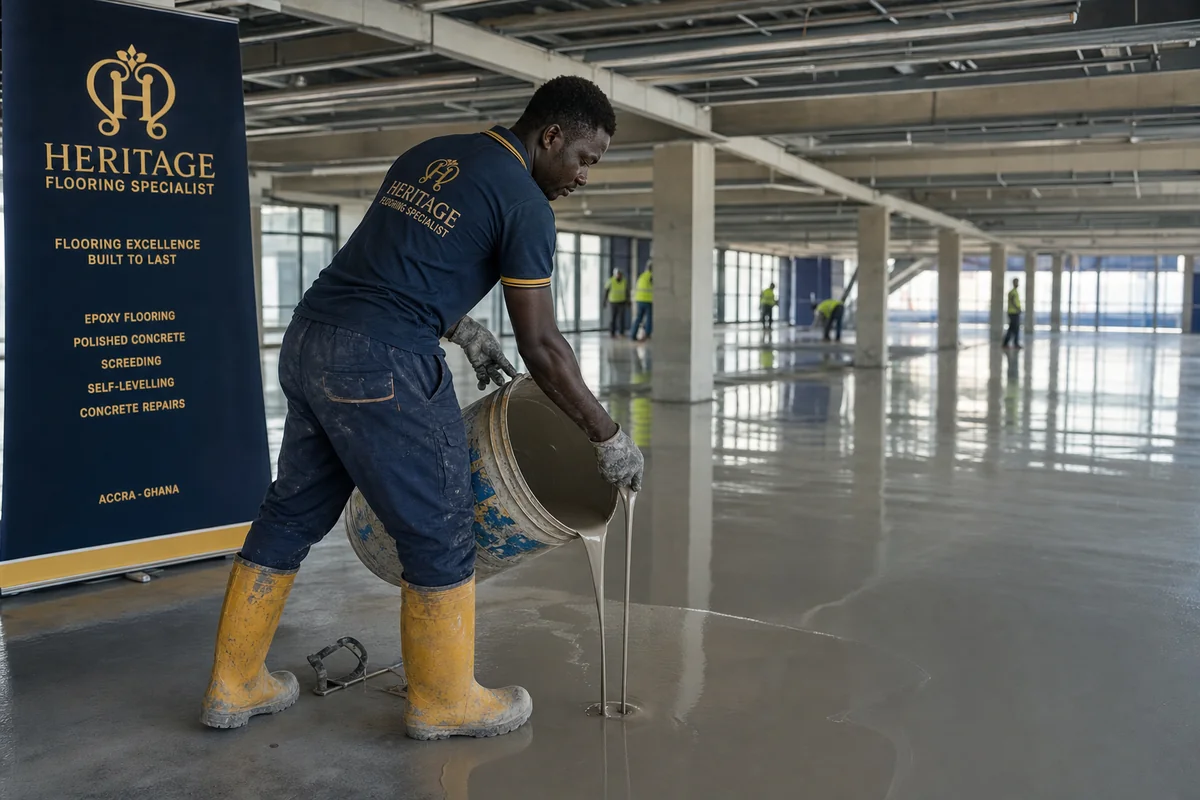
Self-levelling compound is a polymer-modified, cement- or calcium-aluminate-based pourable system that creates a true, flat substrate from an irregular sub-floor. Mixed to a controlled flow and poured across the slab, it seeks its own level under gravity to produce a smooth plane ready to receive the final floor. It is the specification underlay beneath every premium finish that demands a verified-flat base — large-format marble, mirror-finish polished concrete, engineered hardwood and ESD installs where surface continuity governs electrical performance. Floors GH has held this specialty across institutional commissions since 1972.
Why the Substrate Decides the Floor in Ghana’s Conditions
A premium floor is only as good as the slab beneath it, and most concrete slabs in Ghana — particularly buildings poured before 2010 — carry levelness deviation that exceeds what marble, polished concrete, hardwood or resin installs tolerate. Self-levelling compound is the corrective layer that brings the substrate within tolerance before the premium surface is committed. Skip it on an uneven slab and the finish telegraphs every dip, cracks at the high points, or debonds — the single most common cause of premature failure in premium institutional flooring across the region.
Moisture compounds the risk. In Ghana’s persistent 81–83% relative humidity, a substrate holding vapour will undermine both the self-levelling layer and the resin floor above it. We test in-situ slab relative humidity to ASTM F2170 before the pour, and verify the achieved flatness to the ASTM E1155 F-number target after it — so the substrate that goes to the next trade is both flat and sound.
Self-Levelling Systems We Install in Accra
Standard Cement-Based Polymer-Modified
General-purpose levelling for commercial and institutional substrates receiving tile, resin or polished concrete — mixed to the F-number target and poured continuously.
Deep-Fill Levelling
15–40mm builds for heritage and renovation substrates with substantial variance, where a thin skim cannot recover the plane in a single pour.
Calcium-Sulfate / Underfloor-Heating Compatible
Dimensionally stable compounds engineered for underfloor-heating build-ups and screed overlays where movement and thermal compatibility govern.
Fast-Track Thin-Skim
2–4mm skims for substrates with minor variance on a tight programme, curing in hours to keep the receiving install on schedule.
Standards We Work To
| Standard | What it governs | Why it decides the substrate |
|---|---|---|
| ASTM E1155 | Floor flatness / levelness (FF/FL F-numbers) | Sets and verifies the achieved plane — FF35/FL25 commercial up to FF75/FL50 logistics |
| ASTM F2170 | In-situ slab relative humidity | Trapped moisture undermines the compound and the floor above; tested before the pour |
| ICRI CSP | Concrete surface profile after preparation | The bond key the compound keys into — concrete uses ICRI CSP, not steel-only ISO 8501 |
| EN 13892-2 | Compressive / flexural strength of screed material | Confirms the cured compound carries the loads the receiving floor imposes |
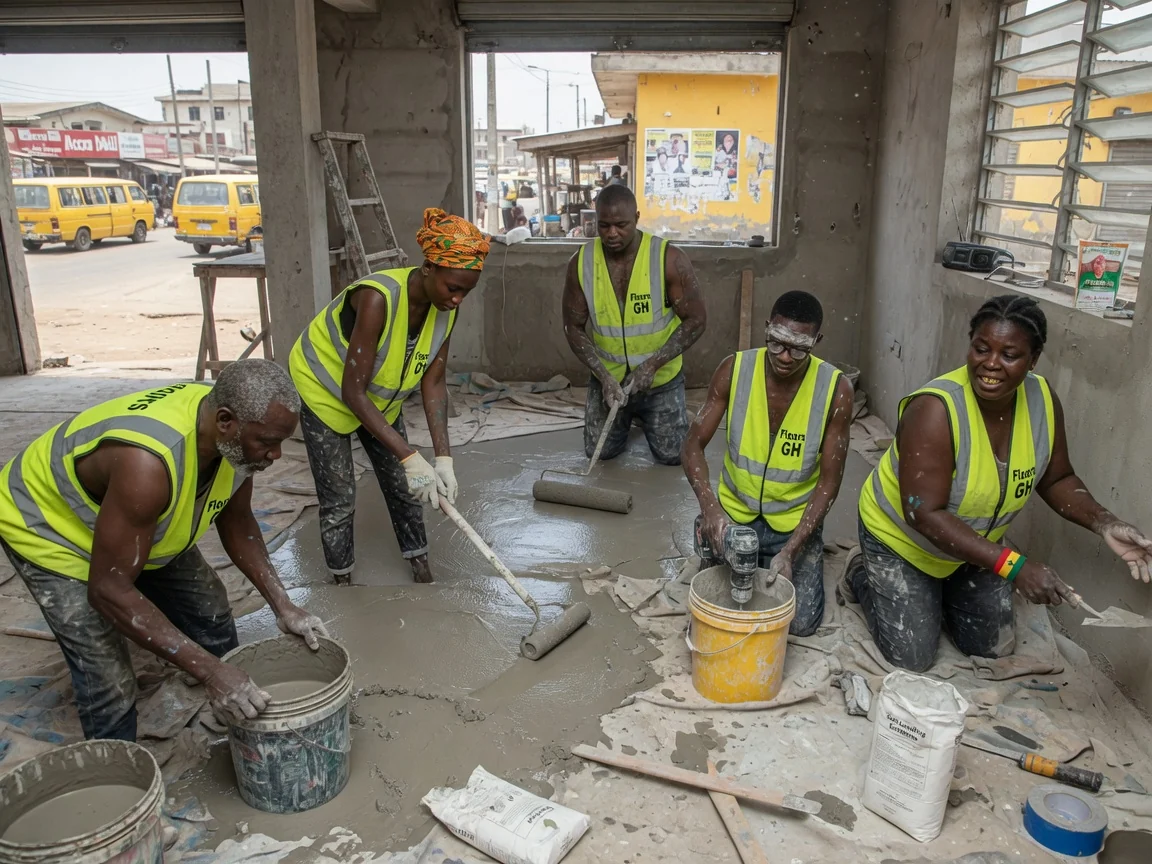
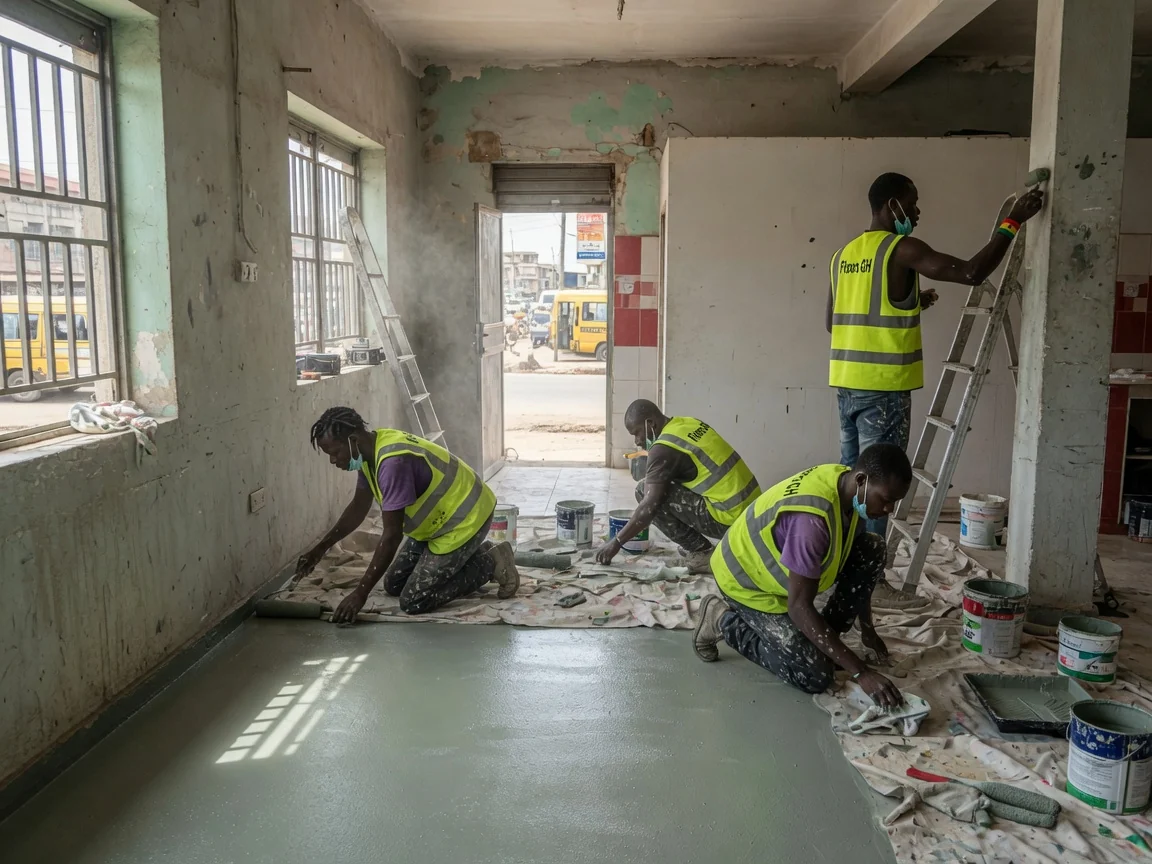
How We Apply a Self-Levelling Substrate
- Substrate survey & moisture testing — flatness vs target F-number (ASTM E1155); slab RH to ASTM F2170.
- Surface preparation — diamond grinding / shot-blasting to ICRI CSP; contamination removed; substrate-appropriate primer.
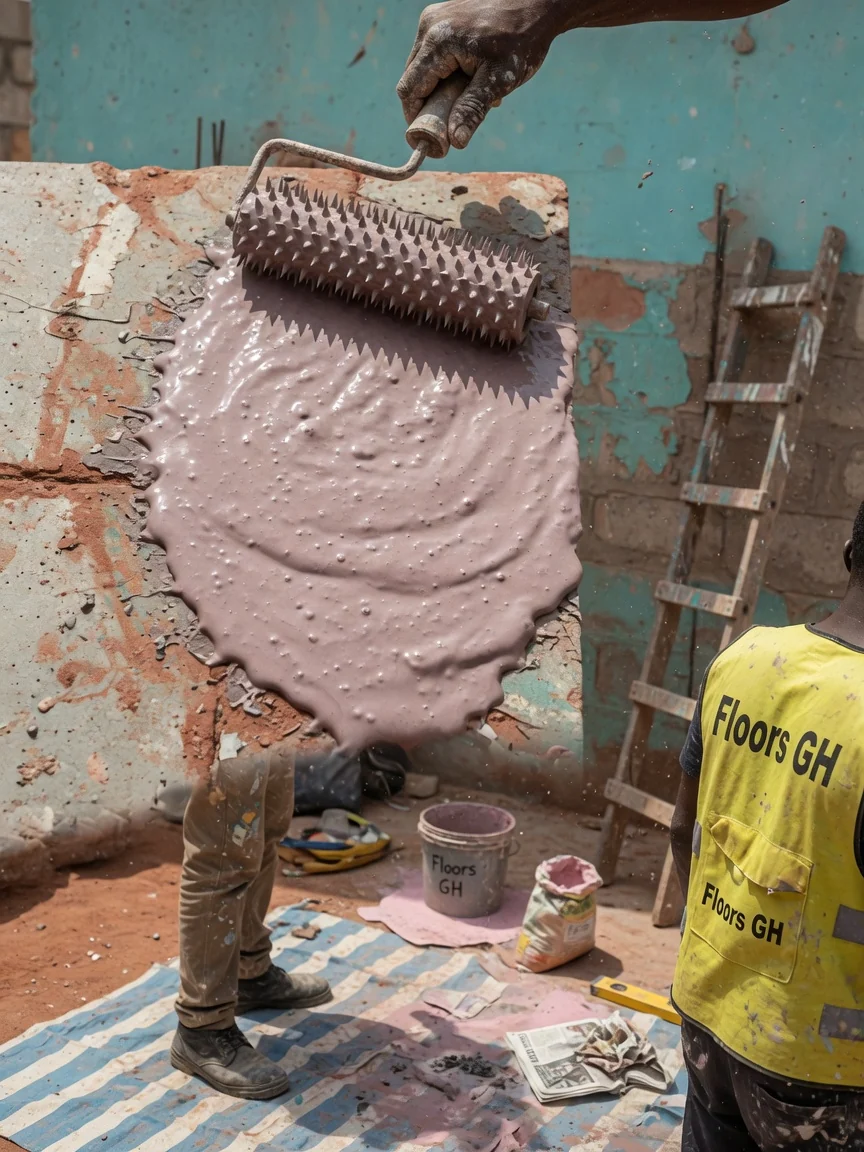
- Mixing & continuous pour — strict water ratio, single continuous pour, spike-roller air release.
- Set verification & handover — F-numbers measured and documented; verified-flat substrate handed over with QC dossier.
Comparing Substrate Preparation Approaches
| Approach | Best for | Tolerance achievable | Moisture handling |
|---|---|---|---|
| Thin-skim self-levelling | Minor variance, fast programme | FF35/FL25 | Primer to slab RH reading |
| Deep-fill self-levelling | Heritage / large variance | FF35/FL25–FF50/FL35 | Moisture-mitigation primer where ASTM F2170 requires |
| Mechanical grind only | Light correction on sound slab | Limited | No film added; slab tested before next trade |
| Re-pour / structural topping | Failed or out-of-tolerance slab | Project-specified | Full reassessment |
What Affects the Cost
- Application depth (thin-skim, standard, or deep-fill) and the volume of compound required
- Compound system specified (cement-based, calcium-sulfate, underfloor-heating compatible)
- Primer system for absorbent or non-standard substrate, and any moisture-mitigation primer
- Substrate preparation effort to reach the required ICRI CSP
Every quote follows a site survey and F-number measurement — no fixed rate is given before substrate variance is measured.
Applications Across Ghana
- Heritage and renovation substrates beneath new marble, parquet and polished concrete
- Corporate office and hospitality refurbishments transitioning to premium finishes
- Pharmaceutical and food-facility floors requiring a verified-flat base before resin coating
- Premium residential extensions across Airport Residential, Cantonments, East Legon and Ridge
- Institutional and logistics substrates in Tema, Spintex and the Takoradi port corridor
Areas We Serve
Floors GH prepares self-levelling substrates across Airport Residential, Cantonments, East Legon, Ridge and Greater Accra — plus Tema, Spintex, Kumasi, Takoradi and Sekondi.
Related Services
- Polished Concrete — the premium finish a flat substrate makes possible
- Marble Installation — large-format laying that demands a verified-flat base
- Specification-Grade Epoxy — resin systems built over a sound, level slab
- Anti-Static ESD Flooring — where surface continuity governs electrical performance
Frequently Asked Questions
When is self-levelling compound required? When the existing slab exceeds the dimensional tolerance band the receiving floor system specifies — most Ghana slabs poured before 2010 do. Self-levelling compound brings the substrate within the F-number target (ASTM E1155) so marble, polished concrete, hardwood or ESD installs do not fail prematurely on an uneven base.
Can self-levelling compound be installed in coastal humidity environments? Yes — moisture verification per ASTM F2170 is non-negotiable for coastal installs around Labadi, Teshie and Tema port-side. Where slab moisture is elevated, a moisture-mitigation primer is applied before the pour, because trapped vapour will compromise both the compound bond and the resin floor that follows it.
How long does self-levelling compound take to cure? It depends on depth: thin-skim (2–4mm) 4–6 hours, standard (5–15mm) 12–24 hours, deep-fill (15–40mm) 48–72 hours. Strict cure time is non-negotiable; committing the receiving floor early is the most common downstream failure.
How much does self-levelling compound cost? It is quoted on survey — cost varies with application depth, the compound system specified and the primer required for the substrate. We give no fixed rate before measuring substrate variance; request a site survey.