
Anti-Static ESD Flooring
ANSI/ESD S20.20 and IEC 61340-5-1 compliant ESD flooring in Accra — conductive and static-dissipative resin systems with copper grounding networks for data centres, electronics manufacturing and pharmaceutical facilities, over moisture-tested (ASTM F2170) slabs. Floors GH, since 1972.
Anti-static ESD flooring is a specification-grade resin system engineered to dissipate electrostatic charge to a defined ground reference, protecting sensitive electronics, pharmaceutical product and personnel from discharge events. A conductive or static-dissipative top layer is bonded to a primer that is electrically connected to a copper grounding network beneath the slab; surface resistance is verified across the floor to the specification class — typically 10⁴ to 10⁹ ohms. In Ghana’s humidity, its electrical integrity depends as much on slab moisture control as on the conductive build. Floors GH has held this specification across institutional commissions since 1972.
Why ESD Floors Need Moisture Control in Ghana’s Conditions
An ESD floor is a resin system, and like every resin floor it is decided beneath the surface. In Ghana’s persistent 81–83% relative humidity, vapour rising through an untested slab does two kinds of damage: it lifts the coating — the same blistering failure that destroys epoxy — and it disrupts the electrical continuity the floor exists to provide. A conductive layer that disbonds, or whose grounding path is compromised by moisture under the primer, is a floor that no longer protects the equipment above it.
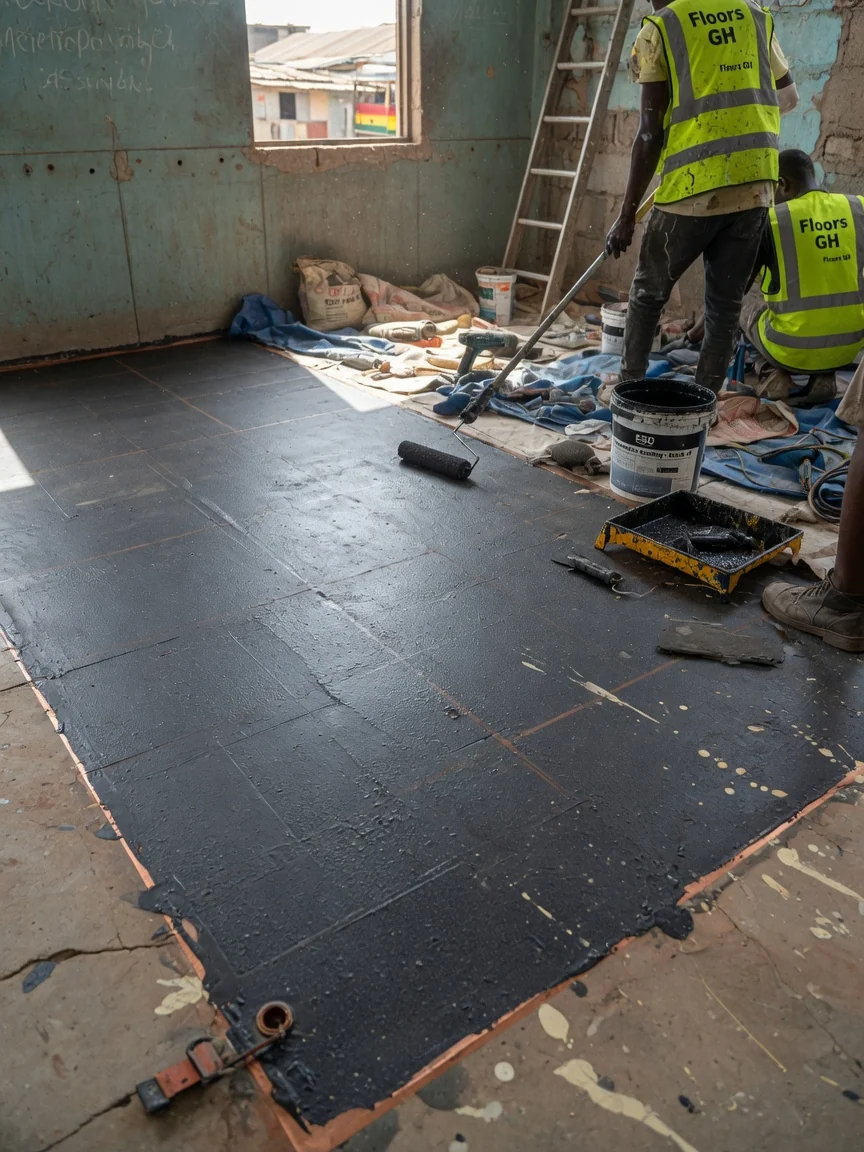
So we treat moisture as a first-order control here. Before any conductive primer is applied we test in-situ relative humidity to ASTM F2170 and prime to the reading. Only then is the copper grounding network laid, embedded and verified, and the resistance-class build applied — so the floor holds both its bond and its specified resistance across a working life of audits and re-tests.
ESD Systems We Install in Accra
Static-Dissipative Epoxy
Surface resistance in the 10⁶–10⁹ ohm band for general electronics, computing rooms and data environments — seamless, hard-wearing and verified to ANSI/ESD S20.20.
Conductive Epoxy
Lower resistance (10⁴–10⁶ ohms) for charge-sensitive electronics manufacturing, switching halls and high-specification handling areas, with a full copper grounding mesh.
ESD Polyurethane
Where abrasion tolerance or thermal movement is also required, a conductive PU build delivers ESD compliance with greater mechanical resilience.
ESD Vinyl / Tile Systems
Conductive vinyl with grounding strips at workstations for assembly floors and operations where a tiled, replaceable surface suits the maintenance regime.

Standards We Work To
| Standard | What it governs | Why it decides the floor |
|---|---|---|
| ANSI/ESD S20.20 | ESD control program; floor resistance & body voltage limits | The governing compliance regime; the resistance class and verification follow it |
| IEC 61340-5-1 | ESD protection of electronic devices; surface resistance | The international counterpart; surface resistance is measured to it at handover |
| ASTM F2170 | In-situ slab relative humidity | Trapped vapour lifts the coating and disrupts continuity; tested before any conductive layer |
| ICRI CSP | Concrete surface profile after preparation | The bond key the conductive primer adheres to — concrete uses ICRI CSP, not steel-only ISO 8501 |
| ASTM D3359 | Coating adhesion (crosshatch tape) | Confirms the conductive build is mechanically bonded, not just laid |
How We Install an ESD Floor
- Specification, survey & moisture testing — resistance class, grounding design, ASTM F2170 slab RH.
- Surface preparation — diamond grinding / shot-blasting to ICRI CSP; conductive primer to the reading.
- Grounding network & conductive build — copper strips bonded to earth, continuity tested, resistance-class layers built.
- Compliance testing & handover — surface resistance to IEC 61340-5-1 / ANSI/ESD S20.20, continuity verified, commissioning certificate.
Comparing ESD Floor Systems for Ghana’s Climate
| System | Resistance band | Best for | Moisture tolerance |
|---|---|---|---|
| Static-dissipative epoxy | 10⁶–10⁹ Ω | General electronics, computing, data | High when slab is tested & primed |
| Conductive epoxy | 10⁴–10⁶ Ω | Electronics manufacturing, switching halls | High; full grounding mesh |
| ESD polyurethane | Per spec | Abrasion / thermal-movement areas | High; flexible build |
| ESD vinyl / tile | Per spec | Assembly floors, replaceable surface | Moderate; substrate must be tested |
What Affects the Cost
- The target resistance class — static-dissipative versus conductive (tighter spec, more verification)
- The grounding network coverage — copper-strip layout, busbar termination, earth-bond verification
- Slab condition and any moisture remediation (ASTM F2170) required
- Certification and documentation overhead — IEC 61340-5-1 / ANSI/ESD S20.20 testing and re-tests
Every quote follows a site survey and slab moisture test — no fixed rate is given before the slab is tested.
Applications Across Ghana
- Data centres and bank server rooms requiring raised-floor charge control
- Electronics manufacturing and assembly facilities supporting the local pipeline
- Pharmaceutical manufacturing and cleanroom-adjacency zones with charge-sensitive product
- Telecommunication switching halls and charge-controlled handling areas
- Electronics and industrial facilities across the Tema and Spintex industrial corridors
Areas We Serve
Floors GH installs anti-static ESD flooring across Airport Residential, Cantonments, East Legon, Ridge and Greater Accra — plus Tema, Spintex, Kumasi, Takoradi and Sekondi.
Related Services
- Specification-Grade Epoxy — the resin platform ESD systems build on
- Polished Concrete — ESD-compliant finish for data-centre surrounds
- Self-Levelling Compound — verified-flat substrate where continuity governs
- Marble Installation — prestige stone for executive zones alongside technical floors
Frequently Asked Questions
What is the difference between anti-static and conductive flooring? Anti-static (static-dissipative) flooring carries surface resistance in the 10⁶–10⁹ ohm band — appropriate for general electronics, computing and data environments. Conductive flooring carries lower resistance (10⁴–10⁶ ohms) — required for the most charge-sensitive areas such as electronics manufacturing assembly and switching halls. Both are specified and verified to ANSI/ESD S20.20 and IEC 61340-5-1.
How is ESD floor performance verified? By measured surface resistance to IEC 61340-5-1 / ANSI/ESD S20.20 at a defined grid density across the floor, plus ground-strap continuity at every grounding point. Results are documented in a commissioning certificate at handover, with scheduled re-tests maintaining the compliance record across warranty life.
Does slab moisture affect an ESD floor in Ghana? Yes — and it is doubly critical here. The ESD floor is a resin system, so in Ghana’s 81–83% humidity trapped slab vapour can both blister the coating and disrupt electrical continuity. We test in-situ RH to ASTM F2170 and prime to the reading before any conductive layer goes down.
How much does an ESD floor cost? It is quoted on survey — cost varies with the target resistance class, the grounding network coverage, the substrate condition and any moisture remediation, plus certification overhead. We give no fixed rate before surveying the slab; request a site survey.