
Specification-Grade Epoxy
Specification-grade epoxy flooring in Accra & Tema — self-levelling, broadcast, anti-slip and ESD resin systems for pharma, food-grade, cleanroom and heavy-traffic floors, with slab moisture testing (ASTM F2170/F1869) that prevents the
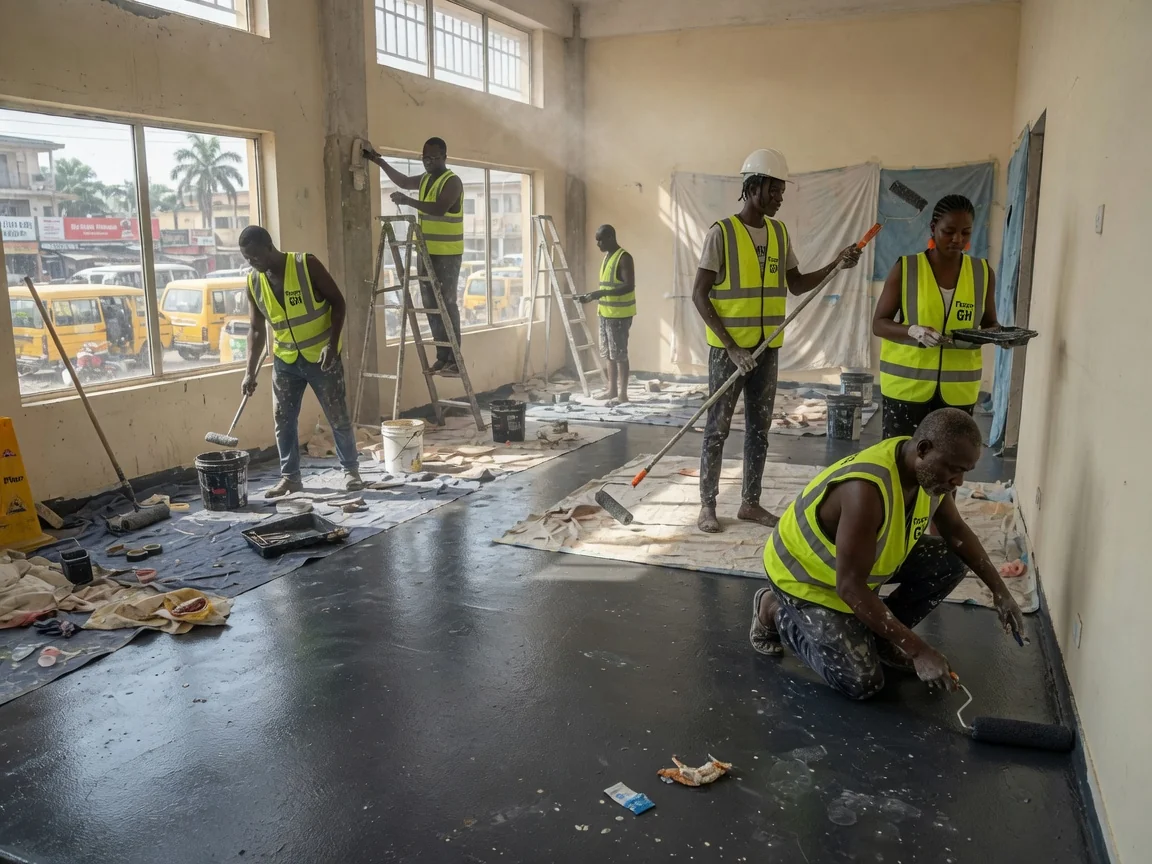
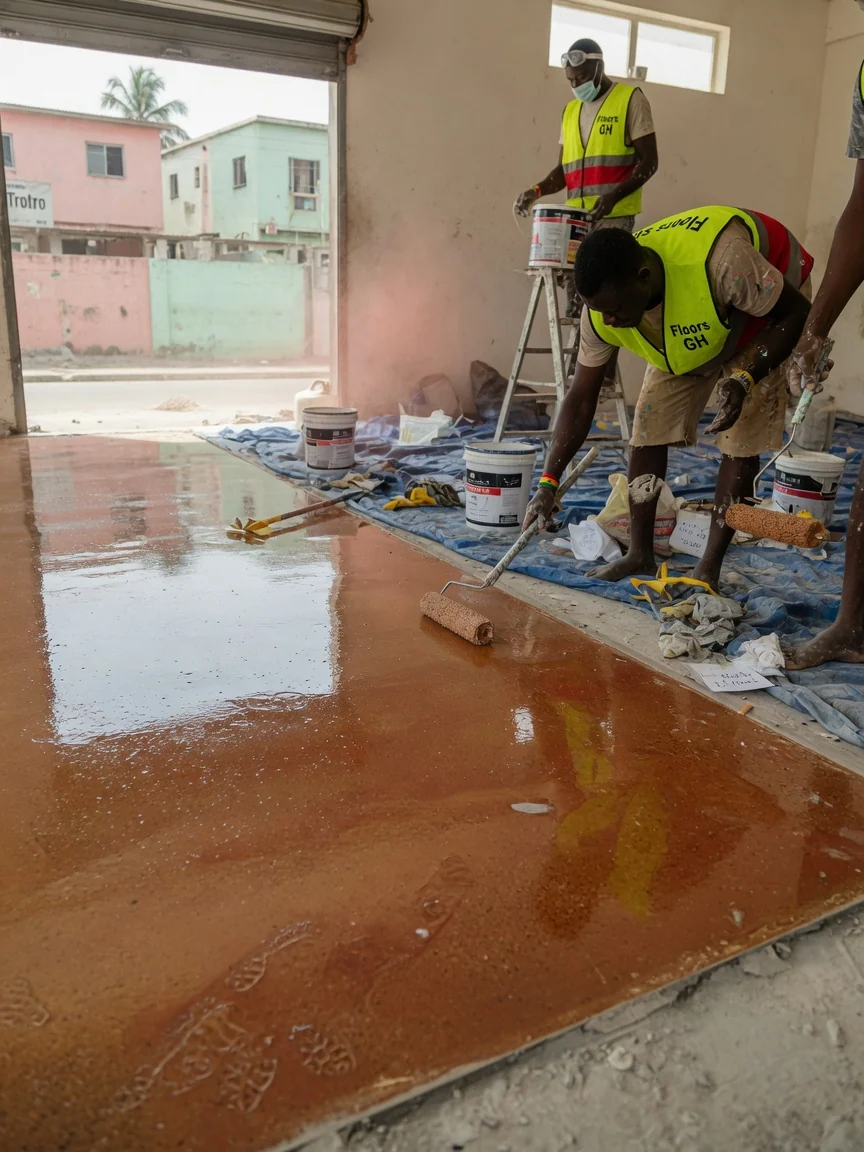
Specification-grade epoxy flooring is a multi-layer, polymer-bound resin system applied over a prepared concrete slab to form a seamless, chemically bonded surface that resists abrasion, chemicals, heavy loads and thermal cycling. In Ghana’s humidity its success is decided beneath the resin — by slab moisture testing and substrate preparation. Floors GH has installed specification-grade epoxy across Accra and Tema’s most demanding institutional and industrial environments since 1972.
Why Most Epoxy Floors Fail in Ghana’s Conditions — and How We Prevent It
The epoxy itself rarely fails; the slab beneath it does. In Ghana’s persistent 81–83% relative humidity, moisture vapour rising through a concrete slab builds osmotic and hydrostatic pressure under the coating and lifts it — blistering, delamination and peeling within months. It is the single most common epoxy-floor failure in the country, and almost every failed floor skipped one step: slab moisture testing before the resin went down.
We treat moisture as the primary engineering control. Before a drop of resin is mixed we test in-situ relative humidity to ASTM F2170 and moisture-vapour emission to ASTM F1869, and prime to the reading. That discipline — not the brand of resin — is what makes a specification-grade floor last in this climate.
Epoxy Systems We Install in Accra & Tema
Self-Levelling Epoxy
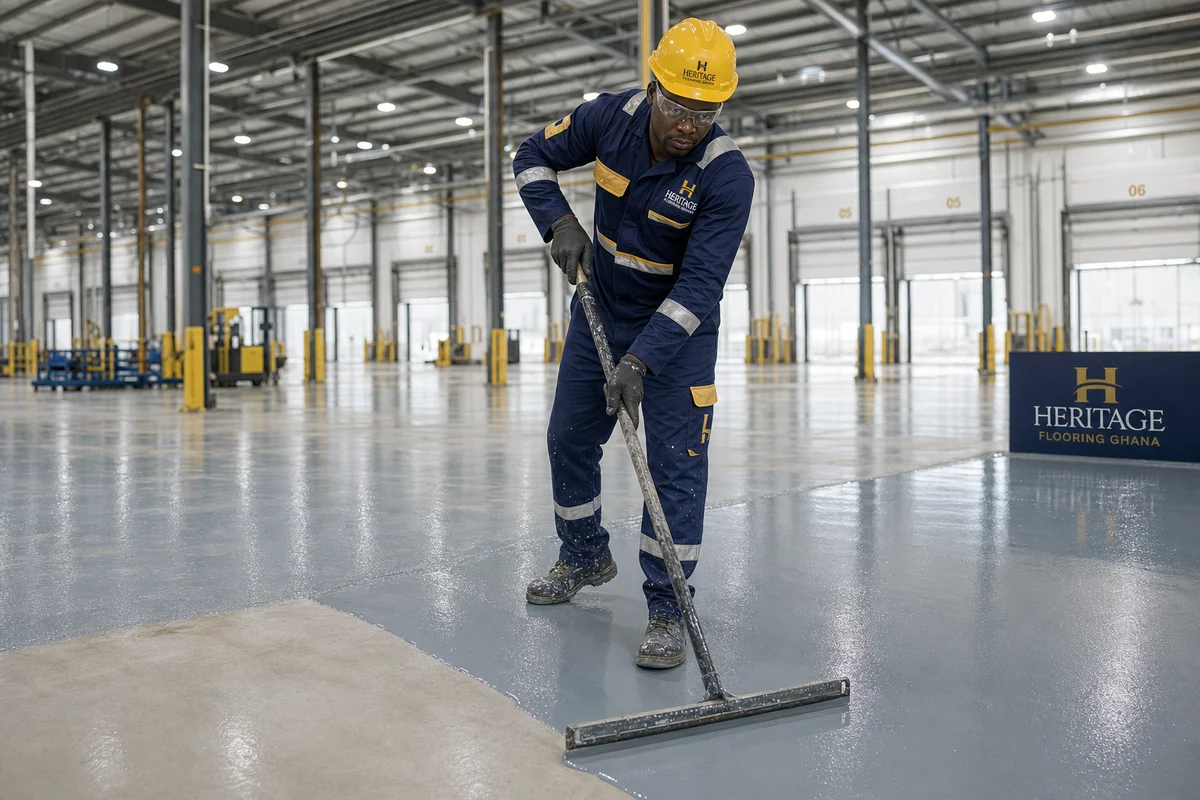
A smooth, seamless, monolithic surface for pharmaceutical suites, cleanroom adjacency and production areas — non-porous, chemical-resistant and built to a defined film thickness, cleanable to validated protocols.
Broadcast / Quartz & Mortar-Body Epoxy
Aggregate-loaded heavy-duty systems for warehouses, loading docks and forklift-traffic areas where impact and rolling loads would defeat a thin coating.
Anti-Slip Epoxy
Profiled systems specified to a target slip rating (EN 16165 ramp method, R9–R13) for wet-process areas, ramps and circulation where safety underfoot is the governing requirement.
Static-Dissipative (ESD) Epoxy
Conductive systems for electronics, pharmaceutical and charge-sensitive environments, specified and verified to ANSI/ESD S20.20 and IEC 61340-5-1.
The Moisture-Testing Doctrine
| Test | What it measures | Why it decides the floor |
|---|---|---|
| ASTM F2170 | In-situ relative humidity (probes at 40% slab depth) | The dominant pre-install moisture test; the resin system and primer are chosen to this reading |
| ASTM F1869 | Calcium-chloride moisture-vapour emission rate | Surface vapour load; flags slabs that need a vapour-suppression primer |
| ICRI CSP | Concrete surface profile after preparation | The mechanical key the resin bonds to — concrete uses ICRI CSP, not the steel-only ISO 8501 |
| EN 16165 | Slip resistance (ramp method, R9–R13) | Sets the anti-slip profile for wet, ramp and circulation areas |
How We Install a Specification-Grade Epoxy Floor
- Slab moisture & substrate testing — ASTM F2170 in-situ RH + ASTM F1869 MVER before anything else.
- Surface preparation — diamond grinding / shot-blasting to the specified ICRI CSP; cracks and voids filled.
- Priming & system build — moisture-tolerant primer to the reading, then the specified system at the correct film build.
- Verification & handover — adhesion (ASTM D3359), slip rating (EN 16165), signed QC dossier under written guarantee.
Comparing Resin & Concrete Floor Systems for Ghana’s Climate
| System | Best for | Lifespan | Moisture tolerance |
|---|---|---|---|
| Self-levelling epoxy | Pharma, food, general production | 10–15+ yrs | High when slab is tested & primed |
| Broadcast / mortar epoxy | Warehouses, docks, forklift traffic | 12–20 yrs | High; thick build |
| PU screed | Food/pharma wash-down, thermal shock | 15–20 yrs | Highest; tolerates wet/thermal cycling |
| Polished concrete | Showrooms, corporate, light commercial | 20+ yrs | N/A — no resin film to lift |
What Affects the Cost
- The system specified (self-levelling, broadcast, anti-slip, ESD or PU screed) and its film build
- Slab condition and any moisture remediation or crack/void repair required
- Area (m²), access, and whether the facility stays operational during works
- Slip rating (EN 16165), chemical resistance and finish specified
Every quote follows a site survey and slab moisture test — no fixed rate is given before the slab is tested.
Applications Across Ghana
- Pharmaceutical, food-grade and beverage facilities requiring hygienic, wash-down-rated systems
- Warehouses, distribution centres and forklift-traffic floors across Tema and Spintex
- Cleanroom adjacency, electronics and ESD environments for charge-sensitive operations
- Premium showrooms and corporate interiors in Airport Residential, Cantonments, East Legon and Ridge
- Industrial facilities across the Tema and Takoradi port corridors
Areas We Serve
Floors GH installs specification-grade epoxy across Airport Residential, Cantonments, East Legon, Ridge and Greater Accra — plus Tema, Spintex, Kumasi, Takoradi and Sekondi.
Related Services
- Polished Concrete — seamless concrete finishing with no resin film to lift
- Self-Levelling Compound — superflat substrate preparation before resin
- Anti-Static ESD Flooring — conductive systems to ANSI/ESD S20.20
- Decorative Terrazzo — for public-facing institutional zones
Frequently Asked Questions
Why do epoxy floors peel or blister in Ghana? Almost always slab moisture. In Ghana’s 81–83% humidity, trapped vapour under the resin builds osmotic and hydrostatic pressure and lifts the coating. The fix is to test in-situ RH (ASTM F2170) and moisture-vapour emission (ASTM F1869) before installation and prime to the reading — which most failed floors skipped.
What epoxy system is best for a pharmaceutical or food facility? A self-levelling or coved hygienic epoxy over a moisture-tested, ICRI-CSP-prepared slab — non-porous, seamless and cleanable to validated protocols. Where wash-down or heavy traffic is severe, a broadcast/quartz body or PU screed is specified instead, chosen to the chemical exposure and slip requirement (EN 16165 R-rating).
How long does an epoxy floor last in Ghana? A correctly specified system over a moisture-tested, properly prepared slab lasts 10–15+ years; the variable is almost never the resin — it is the substrate preparation and moisture control beneath it.
How much does a specification-grade epoxy floor cost? It is quoted on survey — cost varies with the system, film build, slab condition and any moisture remediation, area and access. We never give a fixed rate before testing the slab; request a site survey.