
Heritage Parquet Restoration
Master-restoration of colonial-era and heritage parquet across Accra — forensic survey, species-matched re-lay, and sand-and-refinish to NWFA practice, with humidity acclimation and conservation of the original timber for embassies, diplomatic residences, and protected interiors. Floors GH, the premium flagship since 1972.
Heritage parquet restoration is the specialist discipline of returning original timber-block flooring — herringbone, Versailles panel, or Chantilly pattern installations from the colonial era through the post-independence period — to specification-grade performance while conserving the original timber. The work begins with forensic survey, proceeds through species-matched re-lay, and finishes with sand-and-refinish to NWFA refinishing practice, with humidity acclimation throughout. Floors GH has held this specialty as the empire’s premium flagship since 1972, with documented restorations across embassies, ministerial residences, and protected interiors.
Why Humidity and the Original Timber Govern Heritage Restoration in Ghana
Old timber is still timber — it moves with moisture exactly as new wood does, and in Ghana’s persistent 81–83% relative humidity an unacclimated re-lay cups, gaps, or lifts no matter how skilled the craftsmanship. Heritage substrates carry an added vulnerability: decades of ascending damp through old slabs, which silently undermines any restoration laid over an untested floor. The discipline that makes a restoration last is moisture assessment, acclimation, and conservation of the original timber — not the speed of the re-lay.
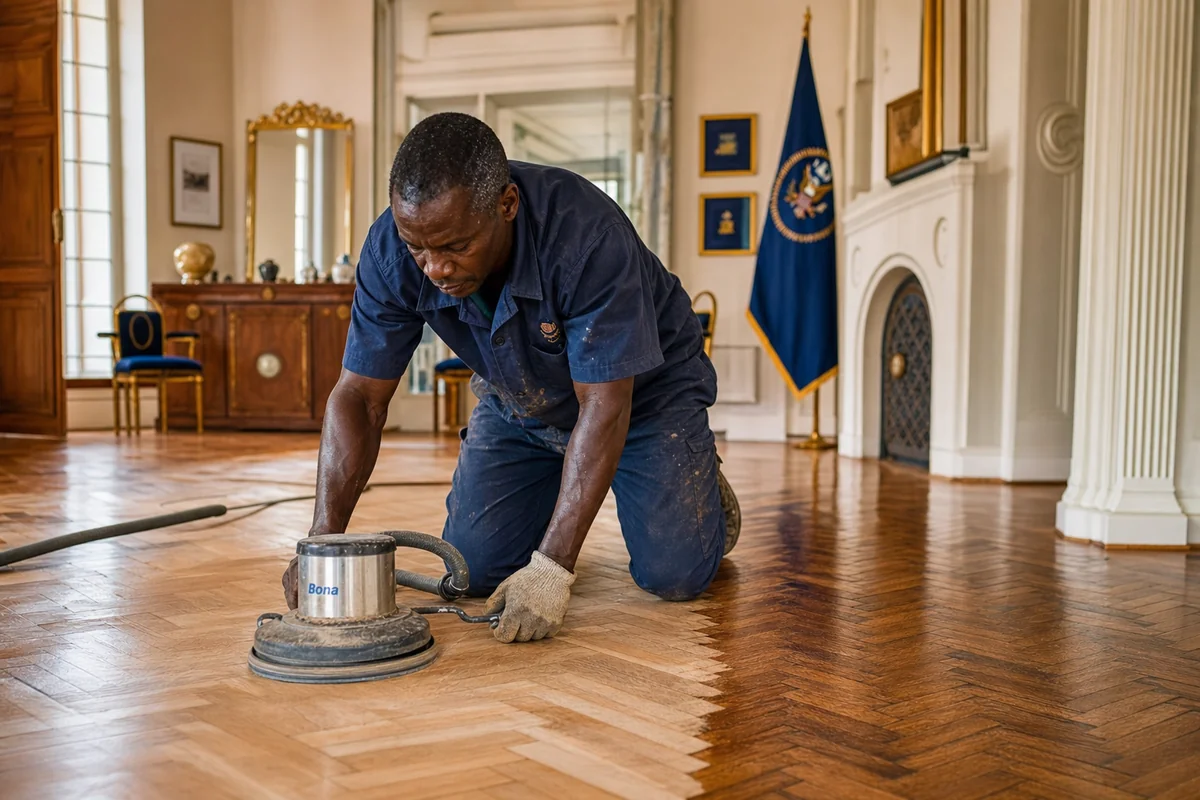
We treat the original fabric and its moisture state as the primary controls. Subfloor and ambient moisture are assessed and remediated first, replacement and re-laid blocks are acclimated to the room’s in-service humidity before fixing, original adhesive residue is removed mechanically to preserve the timber, and sanding is kept conservative to protect the wear layer. That conservation discipline — not wholesale replacement — is what returns a heritage floor to service in this climate.
Heritage Parquet Restoration Services We Provide in Accra
Forensic Survey & Pattern Documentation
Photographic and dimensional mapping of the lay pattern, catalogued missing and damaged blocks, and species/finish identification — the written brief that governs the whole restoration.
Species-Matched Re-Lay
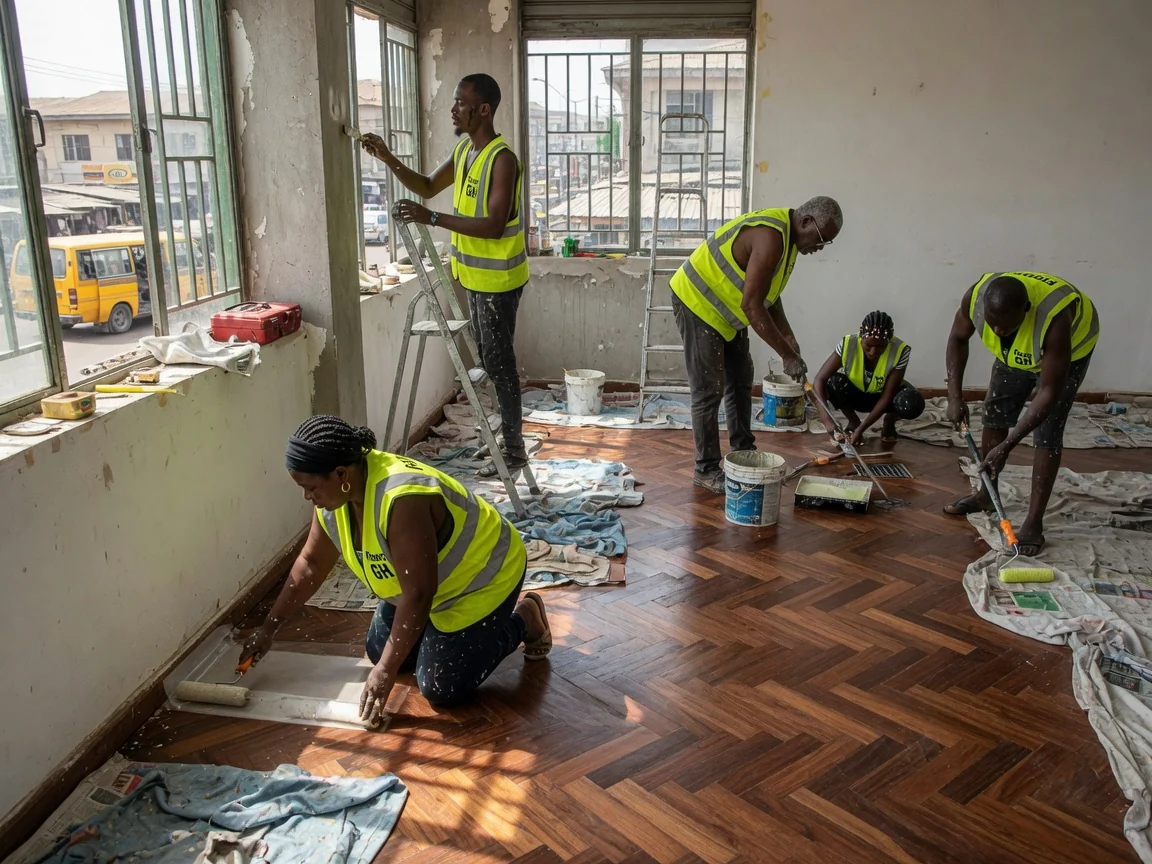
Lifting in documented sequence, sub-floor repair, and re-laying in the original pattern with species- and grain-matched replacement pieces integrated to the field.
Sand & Refinish to NWFA Practice
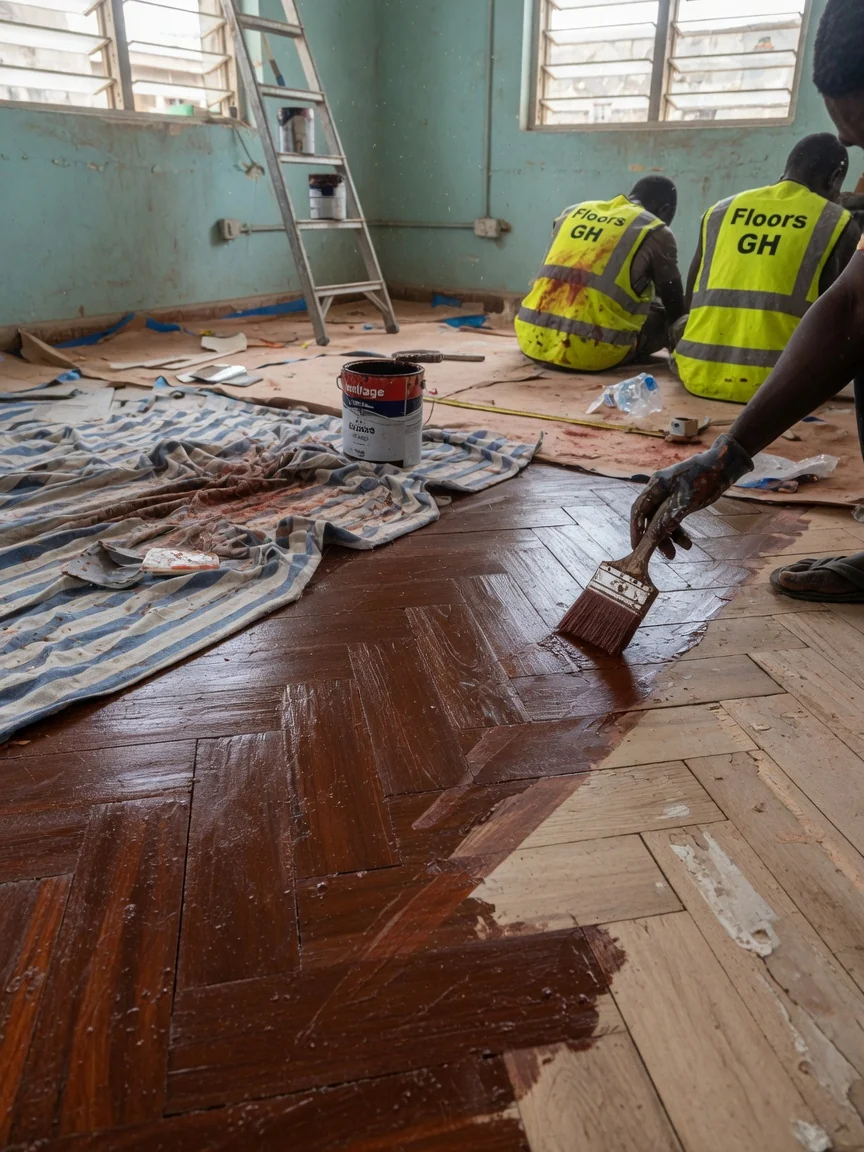
Conservative sanding, species-matched gap-filling, and a multi-coat finish chosen to honour the period register while delivering contemporary durability, to NWFA refinishing practice.
Conservation-Grade Repair
Panel-by-panel lift-and-replace within the existing pattern where damage is localised, with conservation discipline applied to every intervention for embassies, ministry residences, and protected interiors.
The Conservation Doctrine
| Control | What it manages | Why it decides the restoration |
|---|---|---|
| Moisture assessment | Subfloor ascending damp + ambient RH | Heritage substrates fail silently from damp; remediation comes first |
| Acclimation | Equilibrium of blocks to in-service humidity | Unacclimated re-laid blocks cup and gap in Ghana’s humidity |
| Mechanical adhesive removal | Preserving the original timber | Chemical stripping damages the block; mechanical removal conserves it |
| NWFA refinishing practice | Conservative sand-and-refinish | Protects the wear layer and patina that give the floor its value |
How We Restore a Heritage Parquet Floor
- Forensic survey & pattern documentation — photographic/dimensional mapping, catalogued losses, species and finish identification.
- Moisture assessment & acclimation — subfloor and ambient moisture assessed and remediated; blocks acclimated to in-service humidity.
- Species-matched re-lay & sub-floor repair — documented lift, mechanical adhesive removal, sub-floor repair, re-lay in original pattern with matched pieces.
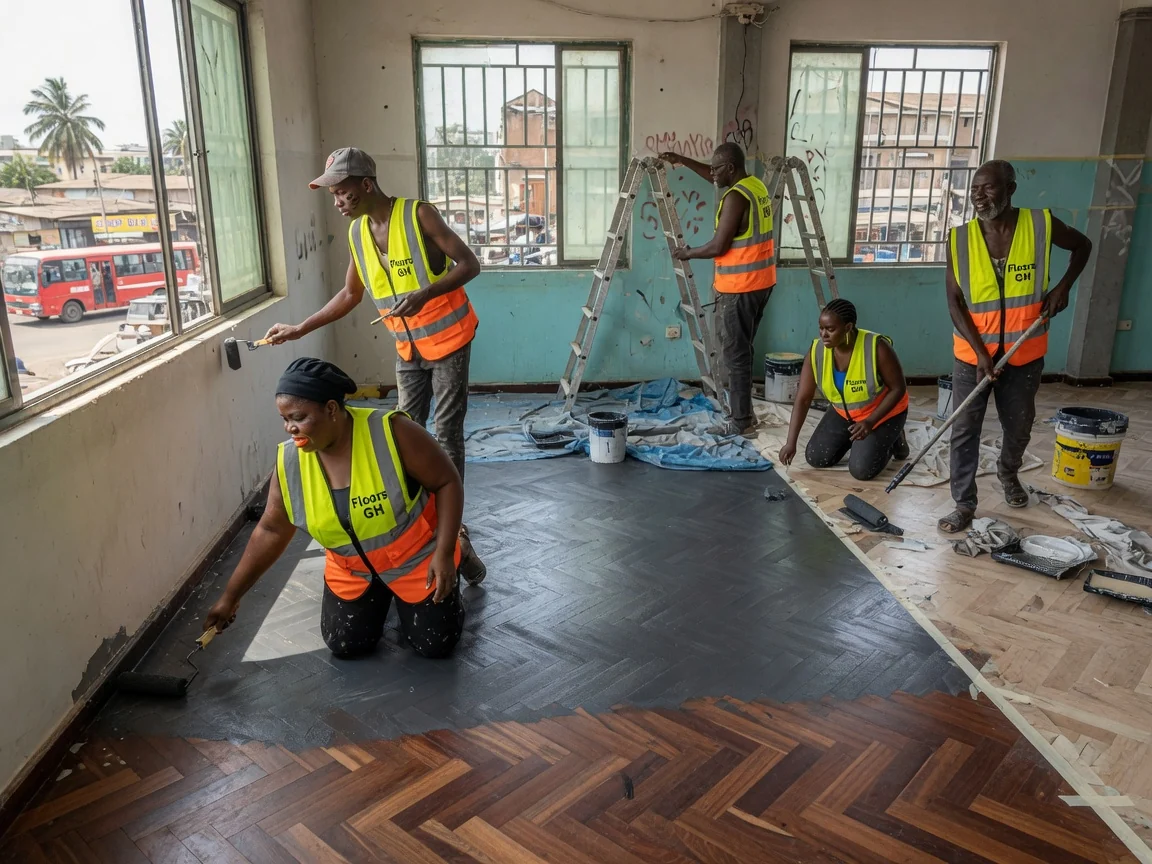
- Sand, refinish to NWFA practice & QC sign-off — conservative sand-and-refinish, period-honouring finish, four-gate QC record.
Comparing Restoration Against Replacement for Ghana’s Heritage Interiors
| Approach | Best for | Preserves heritage register | Outcome |
|---|---|---|---|
| Surface refinish | Intact substrate, minor wear | Yes — fully | Lowest intervention |
| Slab-by-slab re-lay | Cracked, lifted, or chemically damaged panels | Yes — matched pieces | Conservation-grade |
| Full-build restoration | Substantially failed original install | Partially — quarry/species-matched | Recovers the floor |
| New engineered replacement | Original timber unrecoverable | No — erases patina | Modern equivalent only |
What Affects the Cost
- The depth of intervention (surface refinish, slab-by-slab re-lay, or full-build restoration)
- The scarcity and matching of species- and grain-matched replacement timber
- The condition of the heritage substrate and any moisture remediation required
- The lay pattern complexity (herringbone, Versailles panel, Chantilly) and area
- Coordination with heritage architects, conservation consultants, or archival documentation
Every quote follows the forensic survey — no fixed rate is given before the floor is catalogued.
Applications Across Ghana
- Diplomatic missions and residences on the Ridge–Cantonments heritage axis
- Ministerial residences within the Osu and Airport Residential conservation envelopes
- Heritage commercial buildings — early-twentieth-century banks and colonial-era hotels in central Accra and Cape Coast
- Museum gallery and archive interiors where period authenticity is part of the curatorial intent
- Heritage and institutional interiors retaining original timber in Cape Coast and Osu
Areas We Serve
Floors GH restores heritage parquet across Ridge, Cantonments, Airport Residential, and Osu in Greater Accra — plus Cape Coast, Kumasi, and Takoradi.
Related Services
- Engineered Hardwood — contemporary replacement for adjacent rooms
- Marble Installation — for stone-and-timber heritage programmes
- Decorative Terrazzo — for heritage terrazzo restoration in the service spine
- Self-Levelling Compound — sub-floor remediation before re-lay
Frequently Asked Questions
Can heritage parquet be restored rather than replaced? Usually yes. When the original timber is structurally sound, a forensic survey catalogues the floor, species- and grain-matched pieces replace only what is lost, and the field is re-laid in the original pattern and refinished to NWFA practice — conserving the patina and provenance that replacement erases.
How is original timber conserved during restoration? Blocks are lifted in documented sequence, original adhesive residue is removed mechanically rather than chemically wherever possible, sub-floor defects are repaired, and sanding is kept conservative to preserve the wear layer — heritage-conservation discipline applied to every block.
Why does humidity matter in heritage parquet restoration? Because old timber moves with moisture just as new wood does. Replacement and re-laid blocks are acclimated to the room’s in-service humidity before fixing, and subfloor moisture is assessed and remediated first — without this, the restoration cups, gaps, or lifts in Ghana’s humidity regardless of craftsmanship.
How much does heritage parquet restoration cost? It is quoted on survey — cost varies with the depth of intervention (surface refinish, slab-by-slab re-lay, or full-build), the scarcity of species-matched replacement timber, and area. We never give a fixed rate before the forensic survey; request a site survey.