
Polished Concrete
Diamond-polished concrete in Accra — densified, mirror-to-satin finishes for premium retail, corporate lobbies, museum galleries and modern residential. No resin film means no moisture-lift risk, a real advantage in Ghana's 81-83% humidity. Floors GH, since 1972.
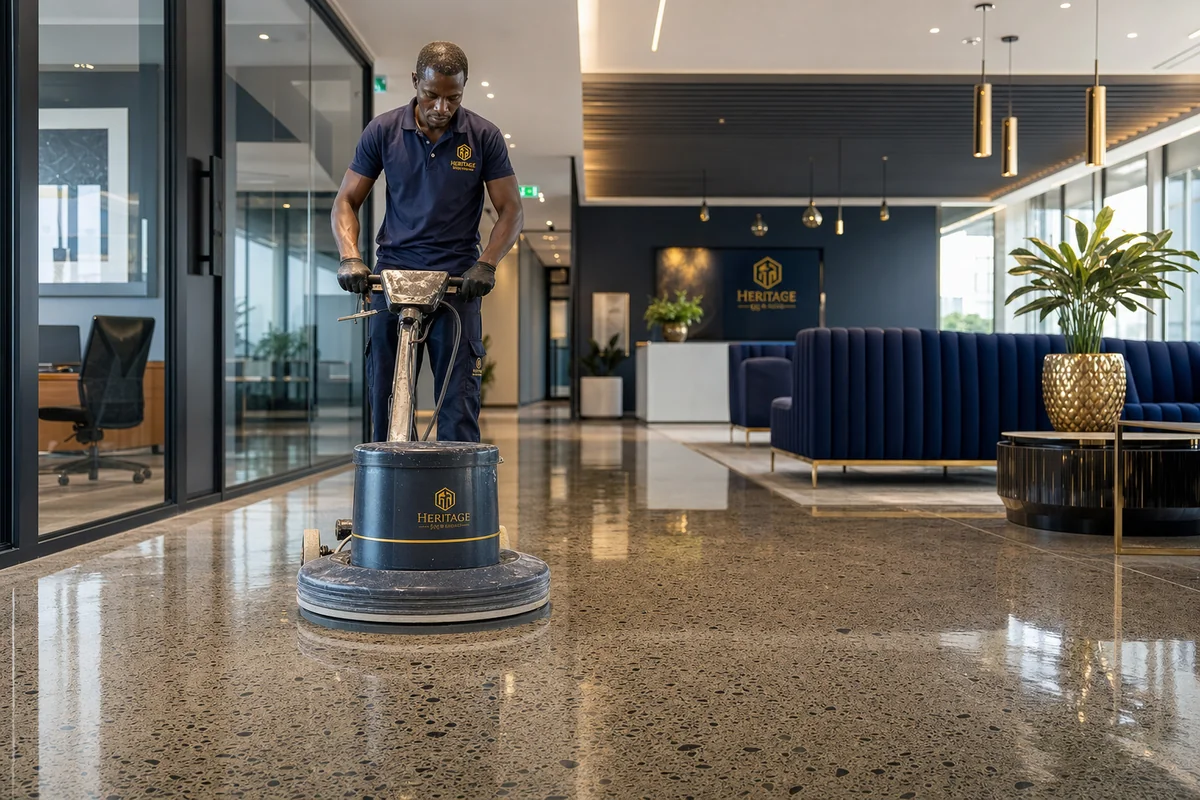
Polished concrete is a multi-stage mechanical finishing process in which a structural or screed slab is progressively refined through bonded-abrasive diamond tooling to a specified reflectivity, from satin-matte to mirror finish. Unlike applied coatings, it transforms the slab itself — a lithium-silicate densifier hardens the cementite matrix before diamond grinding brings it to gloss. The floor is the substrate, not a layer over it. Floors GH has delivered polished concrete across Accra’s premier institutional interiors since 1972.
Why Polished Concrete Suits Ghana’s Conditions
Polished concrete carries a specific climate advantage that resin floors do not. Because it has no resin film bonded over the slab, there is no coating for trapped slab vapour to lift — the failure mode that blisters and peels epoxy in Ghana’s persistent 81–83% relative humidity simply does not exist for a densified polished slab. The surface is the concrete, hardened and refined in place. Where moisture would compromise a resin system, it has nothing to push against here.
That makes polished concrete one of the lower-risk premium specifications for humid environments. The densifier reduces porosity, the diamond-refined surface resists abrasion (ASTM C779), and — correctly sealed — the floor accepts heavy footfall, light spillage and routine cleaning across decades. We still survey the slab so any structural or levelness issue is caught early, but the moisture-lift risk that governs epoxy is off the table.
Polished Concrete Systems We Install in Accra
Densified Satin & Honed
A low-to-mid gloss, composed finish for corporate lobbies, offices and hospitality back-of-house — durable, low-maintenance and contemporary without dating.
High-Gloss Mirror Finish
Progressive grinding to 1500-grit-plus with multi-coat seal for retail flagships, showrooms and reception halls where the floor is a brand statement.
Industrial / FM2 Superflat Polished
Heavy-duty polished slabs combined with FM2/FM3 flatness for distribution centres and high-bay logistics, where superflat tolerance and a finished surface are both required.
ESD-Compliant Polished
Anti-static topcoat over densified concrete for data-centre raised-floor surrounds and electronics environments, with ground-continuity verified to ANSI/ESD S20.20.
Standards We Work To
| Standard | What it governs | Why it matters here |
|---|---|---|
| ICRI CSP | Concrete surface profile after preparation | The base condition the densifier and grits work on — concrete uses ICRI CSP, not steel-only ISO 8501 |
| ASTM F2170 | In-situ slab relative humidity | Assessed for structural assurance — but with no resin film, there is no moisture-lift risk to control |
| ASTM C779 | Abrasion resistance of horizontal concrete | Confirms the densified, polished surface withstands sustained traffic |
| ASTM D523 | Specular gloss / reflectivity | Sets and verifies the target finish, satin through mirror |
| EN 16165 | Slip resistance (ramp method, R9–R13) | Specified where wet or circulation slip safety governs |
How We Install a Polished Concrete Floor
- Specification & substrate survey — slab condition, gloss target (ASTM D523), ASTM F2170 assessment for structural assurance.
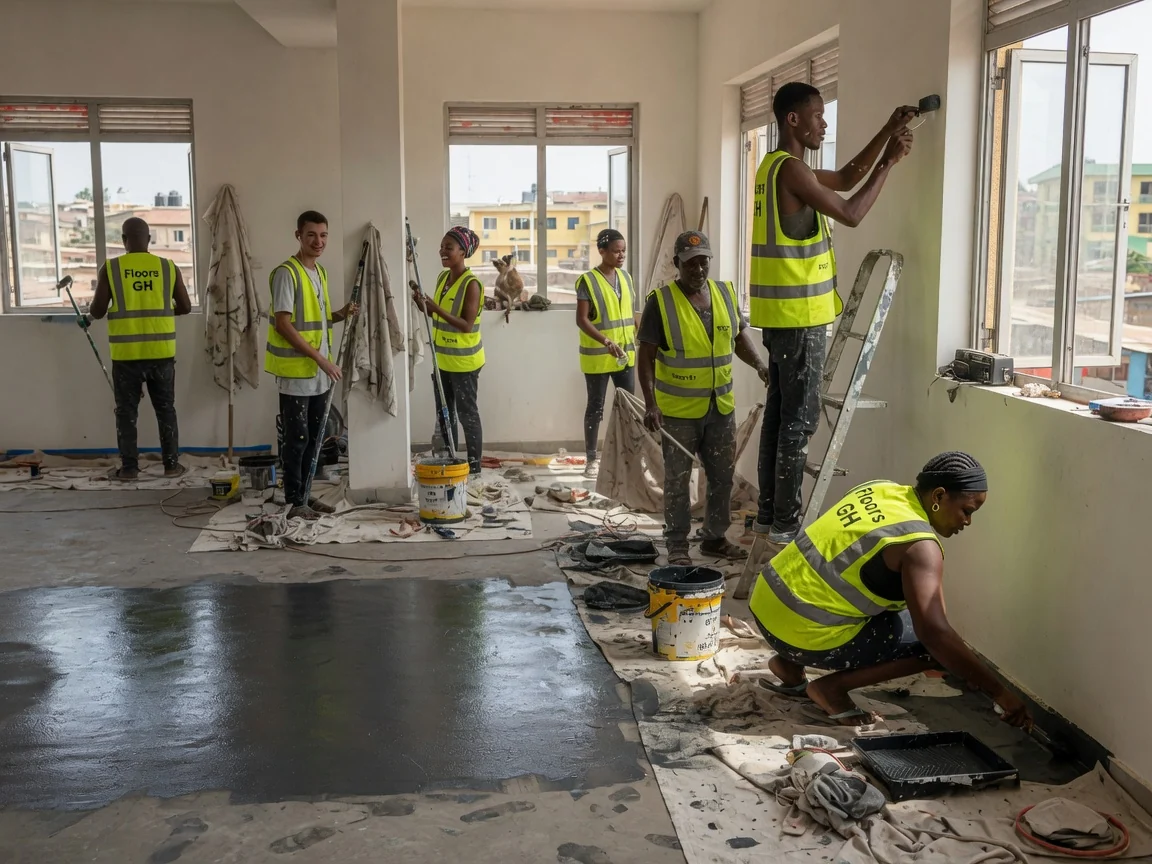
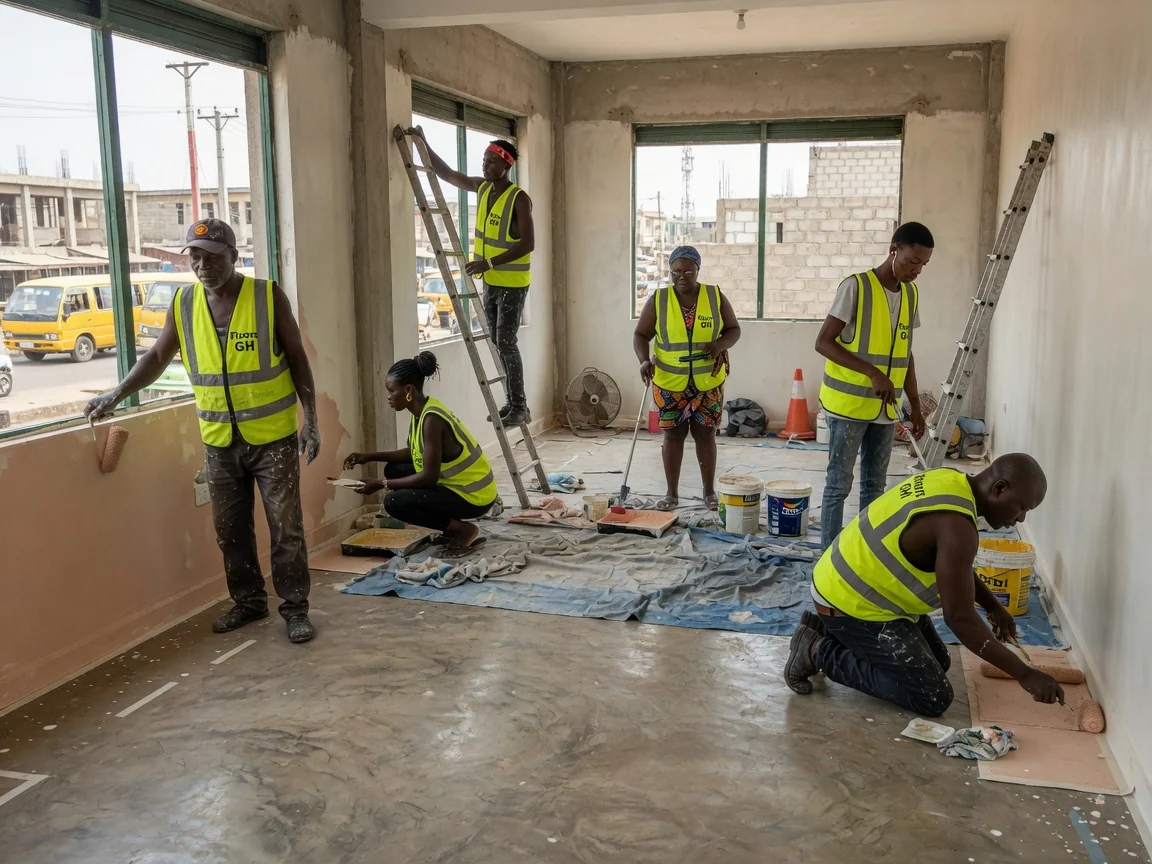
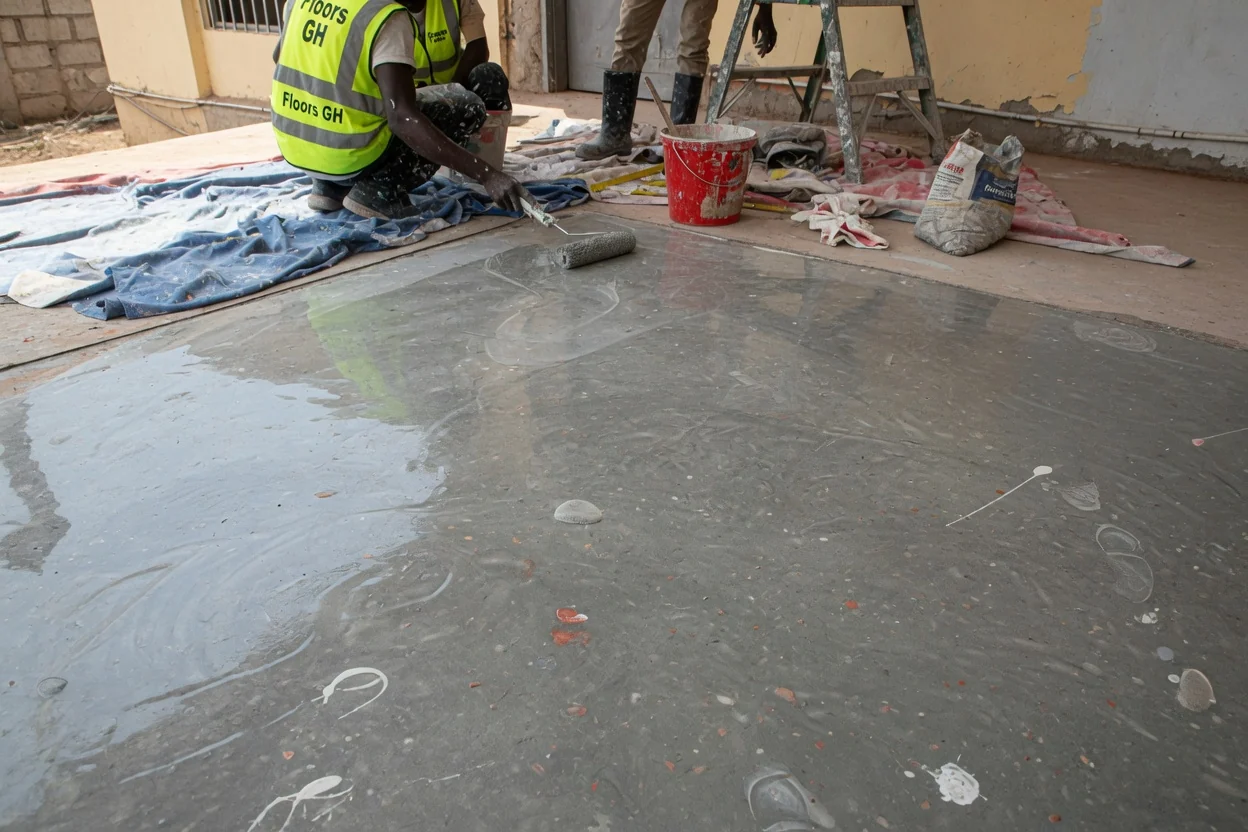
- Surface preparation — coarse diamond passes to the required ICRI CSP; coatings, laitance and contamination removed.
- Progressive grinding & densifying — stepped grits, cross-directional, with lithium-silicate densifier into the matrix.
- Finish, verification & handover — final gloss passes, abrasion (ASTM C779) and slip/ESD checks where required, signed QC dossier.
Comparing Premium Floor Finishes for Ghana’s Climate
| System | Best for | Lifespan | Moisture-lift risk |
|---|---|---|---|
| Polished concrete | Lobbies, retail, corporate, modern residential | 20+ yrs | None — no resin film to disbond |
| Self-levelling epoxy | Pharma, food, production | 10–15+ yrs | Present — needs slab moisture testing |
| Marble installation | Prestige lobbies, executive offices | 30+ yrs | Low — but demands a verified-flat substrate |
| Engineered hardwood | Executive offices, residential | 15–25 yrs | Sensitive — needs moisture-controlled substrate |
What Affects the Cost
- Slab condition and whether full grind-down to aggregate exposure is viable
- Target finish level (satin / honed / 800-grit / 1500-grit-plus mirror)
- Densifier and seal system, and any custom-coloured densifier specified
- Levelness correction (FM2 superflat tolerance adds grinding work)
Every quote follows a site survey — no fixed rate is given before the slab is assessed.
Applications Across Ghana
- Corporate headquarters lobbies and offices in Airport Residential, Cantonments, Ridge and East Legon
- Premium retail flagships, showrooms and hospitality public zones
- Modern architect-led residential extensions across East Legon and Trasacco
- Industrial and distribution floors in Tema and Spintex combining FM2 superflat with a finished surface
- Corporate and institutional interiors across Kumasi and the regional capitals
Areas We Serve
Floors GH installs polished concrete across Airport Residential, Cantonments, East Legon, Ridge and Greater Accra — plus Tema, Spintex, Kumasi, Takoradi and Sekondi.
Related Services
- Specification-Grade Epoxy — resin systems for pharma, food and heavy-traffic floors
- Self-Levelling Compound — superflat substrate preparation before polishing
- Marble Installation — prestige stone in lobby transition sequences
- Anti-Static ESD Flooring — conductive finish for data-centre surrounds
Frequently Asked Questions
Does polished concrete have the moisture-failure problem epoxy has in Ghana? No — and that is its key climate advantage. Polished concrete is the slab itself, not a film bonded over it, so there is no resin layer for trapped slab vapour to lift. In Ghana’s 81–83% humidity, where epoxy blisters when moisture is not controlled, a densified polished slab has no film to disbond — which is why it is often the lower-risk premium specification.
How does polished concrete compare to porcelain tile for corporate offices? Polished concrete is jointless (no grout lines), more abrasion-resistant (ASTM C779), lower-maintenance over a 10-year cycle, and gives a continuous-surface acoustic profile porcelain cannot match. Porcelain installs faster on a tight programme; for most corporate-headquarters briefs in Accra, polished concrete is the recommended specification.
Does polished concrete crack over time? Properly installed and maintained, it stays crack-free for decades. Cracking failures we have remediated were traceable to skipped substrate verification — slab condition and levelness — at install. Our pre-install survey eliminates this failure mode.
How much does polished concrete cost? It is quoted on survey — cost varies with slab condition, target gloss, densifier and seal system, and any levelness correction needed. We give no fixed rate before surveying the slab; request a site survey.