
Engineered Hardwood
Specification-grade engineered hardwood for boardrooms, executive residences, and Tier-1 interiors across Accra — installed to NWFA guidelines with wood-moisture and subfloor testing that controls the cupping and gapping Ghana's 81-83% humidity drives in solid timber. Floors GH, the premium flagship since 1972.
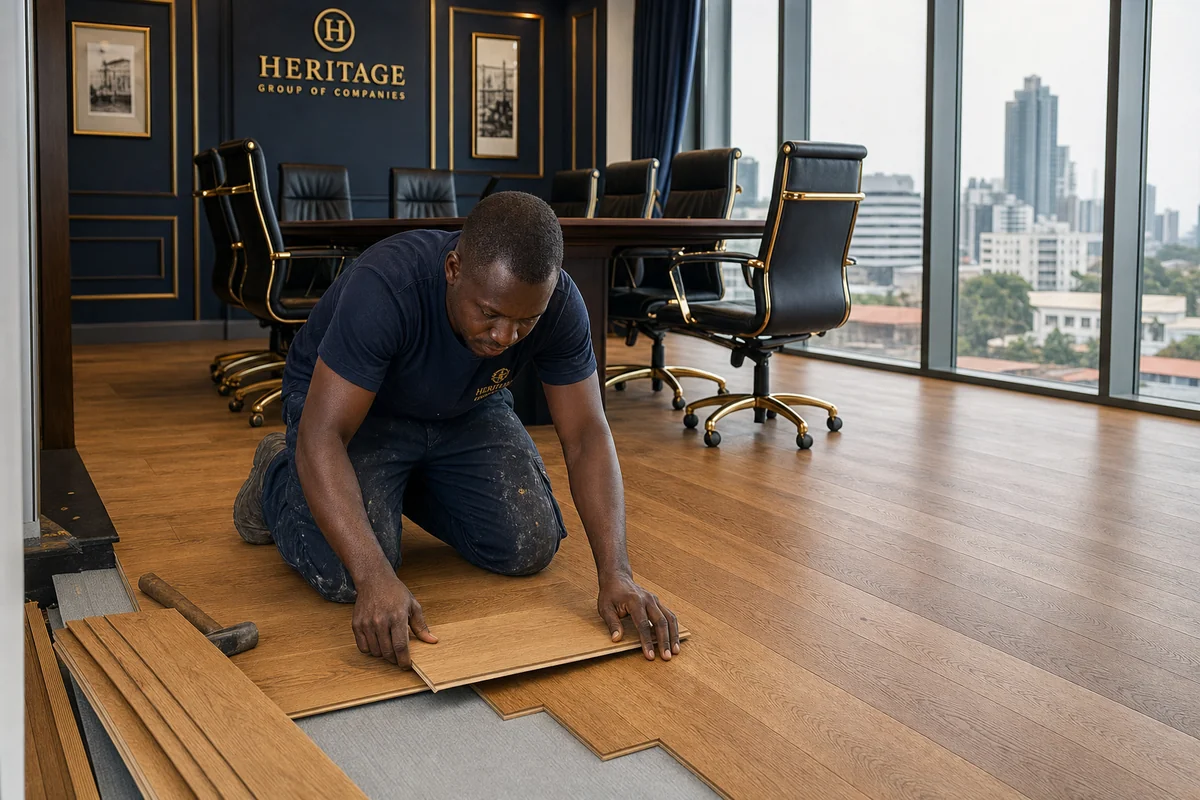
Engineered hardwood is a multi-layer floor in which a kiln-dried hardwood wear layer is bonded to a dimensionally stable cross-laminated core, giving the visual register of solid timber while resisting the moisture movement that constrains solid wood in tropical climates. Installed to National Wood Flooring Association (NWFA) guidelines, with the wear-layer permitting multiple sand-and-refinish cycles across decades, it is the timber specification that holds in Ghana’s humidity. Floors GH has held this specification as the empire’s premium flagship since 1972.
Why Wood Moves in Ghana’s Humidity — and How We Control It
Wood is hygroscopic: it gains and loses moisture with the surrounding air, and as it does, it swells and shrinks. In Ghana’s persistent 81–83% relative humidity, a floor that absorbs moisture cups and a floor that dries out gaps — and this movement, not the species or the finish, is the number-one cause of wood-floor failure in this climate. Solid timber moves most; the failures show up as cupped boards, open gaps between planks, and buckling at the perimeter.
We control moisture as the primary engineering discipline. Before a board is opened we measure the wood moisture content of the flooring and test the subfloor, acclimate the material to the room’s in-service conditions per NWFA guidelines, manage vapour over concrete, and specify engineered (not solid) construction whose cross-laminated core resists movement. That moisture discipline — not the timber grade — is what makes a wood floor hold in Ghana.
Engineered Hardwood Systems We Install in Accra
European Oak Engineered
The mid-tier institutional standard — stable, refinishable, and available in a wide register of finishes for boardrooms, executive residences, and premium hospitality suites.
Tropical & Exotic Veneers (Walnut, Teak, Acacia)
Top-tier species whose density and natural stability suit coastal and high-humidity applications, specified where the brief calls for material weight and character.
Wide-Plank & Pattern (Herringbone, Chevron)
Specification-grade wide-plank and parquet-pattern engineered boards laid to NWFA method, with expansion control across large fields.
Oil-Finish & UV-Lacquer Systems
UV-cured lacquer for low-maintenance durability, or oil-finish for a natural register that refreshes by re-oiling rather than full sanding — selected to the maintenance brief.
The Wood-Moisture Doctrine
| Control | What it manages | Why it decides the floor |
|---|---|---|
| Wood moisture content | Equilibrium between board and in-service air | The board must reach the room’s humidity before it is fixed, or it moves afterward |
| NWFA acclimation | Conditioning material to the building’s living conditions | NWFA guidelines acclimate to in-service conditions, not a fixed number of days |
| Subfloor moisture testing | RH/surface moisture on concrete; meter on timber | An untested subfloor drives moisture into the floor and causes cupping |
| Engineered cross-laminated core | Dimensional stability vs solid timber | Resists the cupping, gapping, and warping humidity imposes on solid wood |
How We Install an Engineered Hardwood Floor
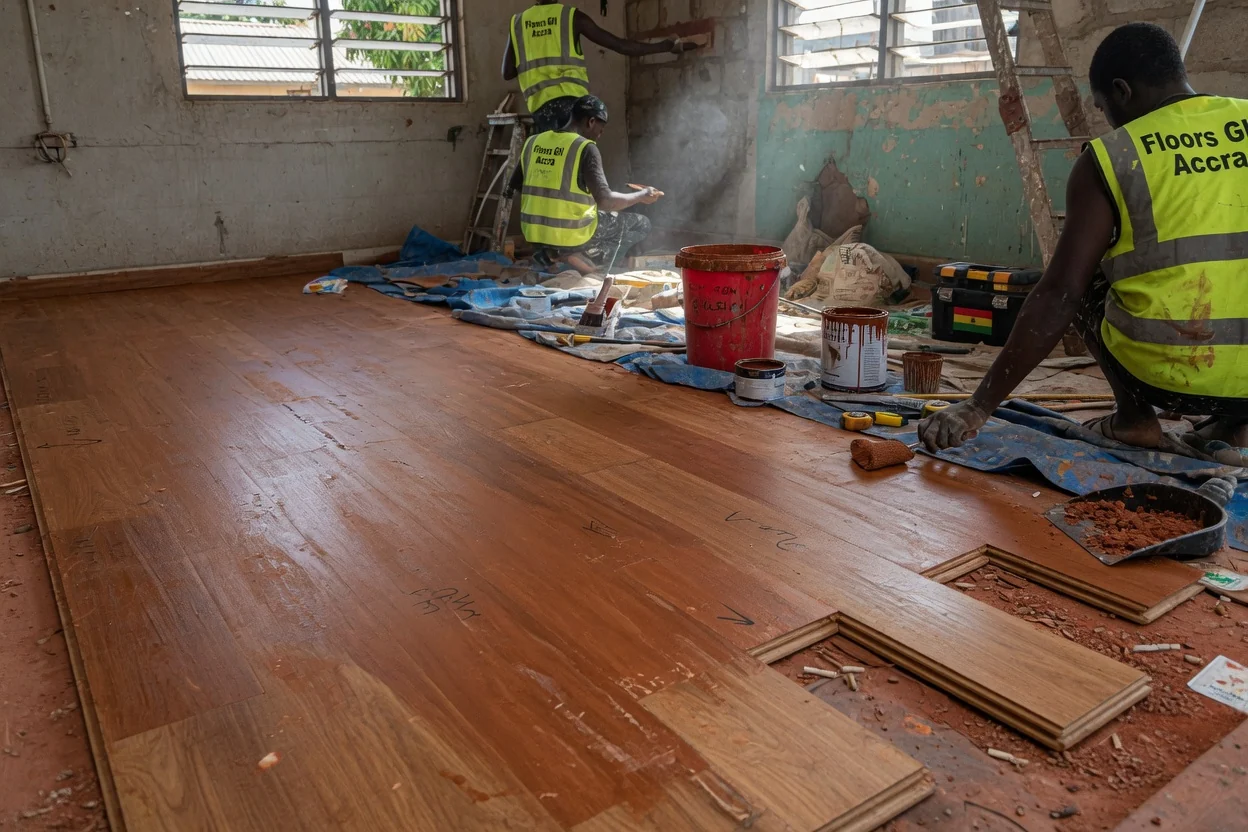
- Moisture testing & survey — wood moisture content of the flooring + subfloor RH/surface moisture to the NWFA window before anything is opened.
- Acclimation to NWFA guidelines — material conditioned on site to the room’s in-service conditions, humidity logged daily.
- Subfloor preparation & vapour management — flat to NWFA tolerance, self-levelling where required, vapour retarder/underlayment over concrete.
- Installation, expansion gaps & finish — floated/glued/nailed per substrate, expansion gaps at every wall and threshold, finish inspected and handed over with a care protocol.
Comparing Wood Floor Options for Ghana’s Climate
| System | Best for | Humidity stability | Refinish cycles |
|---|---|---|---|
| Engineered hardwood | Boardrooms, executive residences, hospitality | High — cross-laminated core | 1–3 (by wear layer) |
| Solid hardwood | Heritage/period briefs only, with aggressive moisture control | Low — moves with humidity | Many, but high cupping risk |
| Laminate | Budget / temporary fit-out | Moderate (no real wood) | None — cannot be refinished |
| Heritage parquet | Restoration of original timber blocks | Managed via conservation | Refinish to NWFA practice |
What Affects the Cost
- The species and wear-layer thickness (European oak through tropical exotics; 3mm through 6+mm)
- The finish system (UV-cured lacquer, oil-finish, or bespoke distressed/aged)
- The subfloor condition and any moisture remediation, levelling, or vapour management required
- The lay pattern (straight, herringbone, chevron) and area
- Whether underfloor heating or existing-floor removal is involved
Every quote follows a site survey and moisture test — no fixed rate is given before the subfloor is tested.
Applications Across Ghana
- Corporate boardrooms and executive-floor suites in Ridge and East Legon
- Luxury residential principal living areas, family rooms, and master suites in Airport Residential, Cantonments, and Trasacco
- Boutique hotel and executive-residence guest suites where guest experience is governed by material register
- Coastal residences (Labadi, Teshie) where tropical-stable veneers outperform temperate species
- Premium residential and hospitality interiors in East Legon and Trasacco
Areas We Serve
Floors GH installs engineered hardwood across Airport Residential, Cantonments, East Legon, and Ridge in Greater Accra — plus Trasacco, Kumasi, and Takoradi.
Related Services
- Heritage Parquet Restoration — conservation of original timber-block floors
- Marble Installation — for lobby-to-boardroom transitions
- Polished Concrete — for zoned back-of-house surfaces
- Self-Levelling Compound — subfloor preparation before timber installation
Frequently Asked Questions
Why does wood flooring cup or gap in Ghana? Because wood moves with humidity. In Ghana’s persistent 81–83% relative humidity, a board that absorbs moisture swells and cups; one that dries out shrinks and gaps. The controls are NWFA-guideline acclimation to the room’s in-service conditions, subfloor moisture testing before installation, vapour management over concrete, and engineered (not solid) construction.
Is engineered hardwood better than solid wood in a tropical climate? Yes. Engineered hardwood bonds a real hardwood wear layer to a dimensionally stable cross-laminated core, so it resists the cupping, gapping, and warping that humidity swings impose on solid timber. The visual register is identical; the dimensional stability is far better suited to Ghana’s humidity.
Can an engineered hardwood floor be sanded and refinished? Yes — the number of cycles depends on the wear-layer thickness: a 3mm lamella takes roughly one sand-and-refinish, 4–6mm takes two, to NWFA refinishing practice. That is the key advantage over laminate, which cannot be refinished at all.
How much does engineered hardwood cost? It is quoted on survey — cost varies with the species and wear-layer thickness, the finish system, the subfloor condition and any moisture remediation, and area. We never give a fixed rate before testing moisture and surveying the subfloor; request a site survey.