
Decorative Terrazzo
Specification-grade decorative terrazzo across Accra — cementitious and epoxy terrazzo installed to NTMA methods, with divider strips, diamond grind-and-polish, and ASTM C779 abrasion resistance over a properly prepared substrate. Floors GH, the broad premium flagship since 1972.
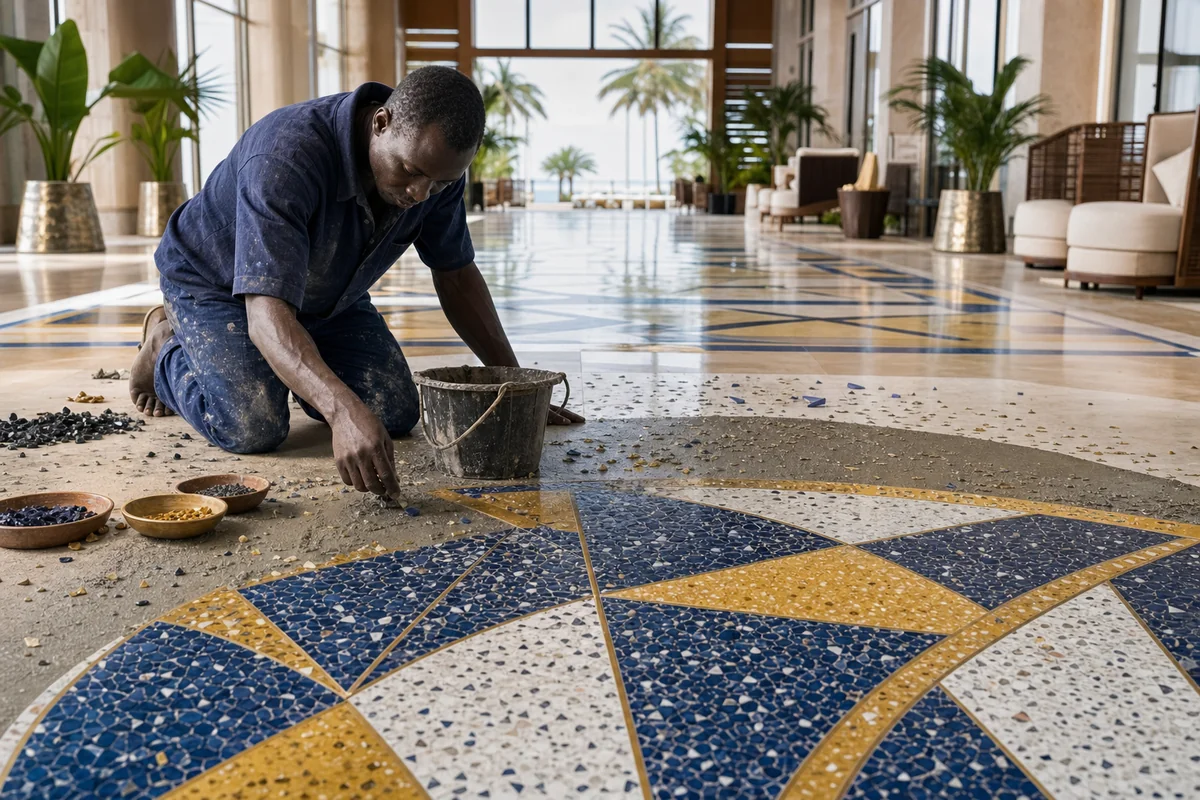
Decorative terrazzo is a poured-in-place composite floor in which selected aggregate — marble chip, glass cullet, mother-of-pearl, or bespoke material — is bound in a cementitious or epoxy matrix, ground flat after cure, and progressively polished to a specified gloss. The result is a monolithic, jointless field, individually composed for each commission and laid to the methods of the National Terrazzo & Mosaic Association (NTMA). Floors GH has held this specialty as the empire’s broad premium flagship since 1972, with installations across hotel public spaces, ministerial atriums, and gallery interiors.
Why Terrazzo Succeeds or Fails on the Substrate in Ghana’s Conditions
A terrazzo floor is a single continuous monument poured over a slab — so its success is decided by the substrate beneath it. A poorly prepared, uneven, or moving slab telegraphs straight through the topping as cracking and debonding, and no amount of aggregate selection or polish recovers it. The discipline that makes terrazzo last is substrate preparation and divider-strip layout, not the decorative composition.
We treat the substrate as the primary engineering control. The receiving slab is ground or shot-blasted to a sound, mechanically keyed profile, cracks and voids are filled, flatness is verified to ASTM E1155, and divider strips are set to the NTMA-recommended panel layout so shrinkage and substrate movement localise at the strip rather than fracturing the field. That groundwork — not the aggregate — is what makes a terrazzo floor hold for decades in this climate.
Decorative Terrazzo Systems We Install in Accra
Cementitious (Portland-Cement) Terrazzo
The traditional bonded or sand-cushion system, mixed and placed to NTMA proportioning. Thicker-bodied and ideal for large institutional fields, heritage matching, and where a traditional register is specified.
Epoxy (Resin-Matrix) Terrazzo
A thinner, faster-curing, low-permeability system with brighter aggregate clarity and a wider colour range — suited to commercial fields, retail flagships, and tighter thickness budgets where chemical resistance matters.
Divider-Strip & Bespoke-Aggregate Terrazzo
Brass, zinc, or aluminium divider strips set to a designed pattern, with bespoke aggregate (mother-of-pearl inlay, recycled glass cullet, regional stone) for commissions where the floor is the principal architectural statement.
Heritage Terrazzo Restoration
Re-grind, re-pour, and period-matched aggregate sourcing for mid-century terrazzo that has reached end-of-cycle, preserving the original register while remediating substrate failure.
The NTMA Method & Standards Doctrine
| Reference | What it governs | Why it decides the floor |
|---|---|---|
| NTMA methods | Matrix proportioning, divider-strip panel layout, grind-and-polish sequence | The recognised installation methodology for both cementitious and epoxy terrazzo |
| ASTM C779 | Abrasion resistance of horizontal concrete/terrazzo surfaces | Verifies the wear performance a high-traffic public floor must hold |
| ASTM E1155 | Floor flatness (FF/FL numbers) | The receiving plane a poured monolithic field needs before any matrix is placed |
| Divider-strip layout | Controlled break-lines at panel edges | Localises shrinkage and substrate movement at the strip, preventing field cracking |
How We Install a Decorative Terrazzo Floor
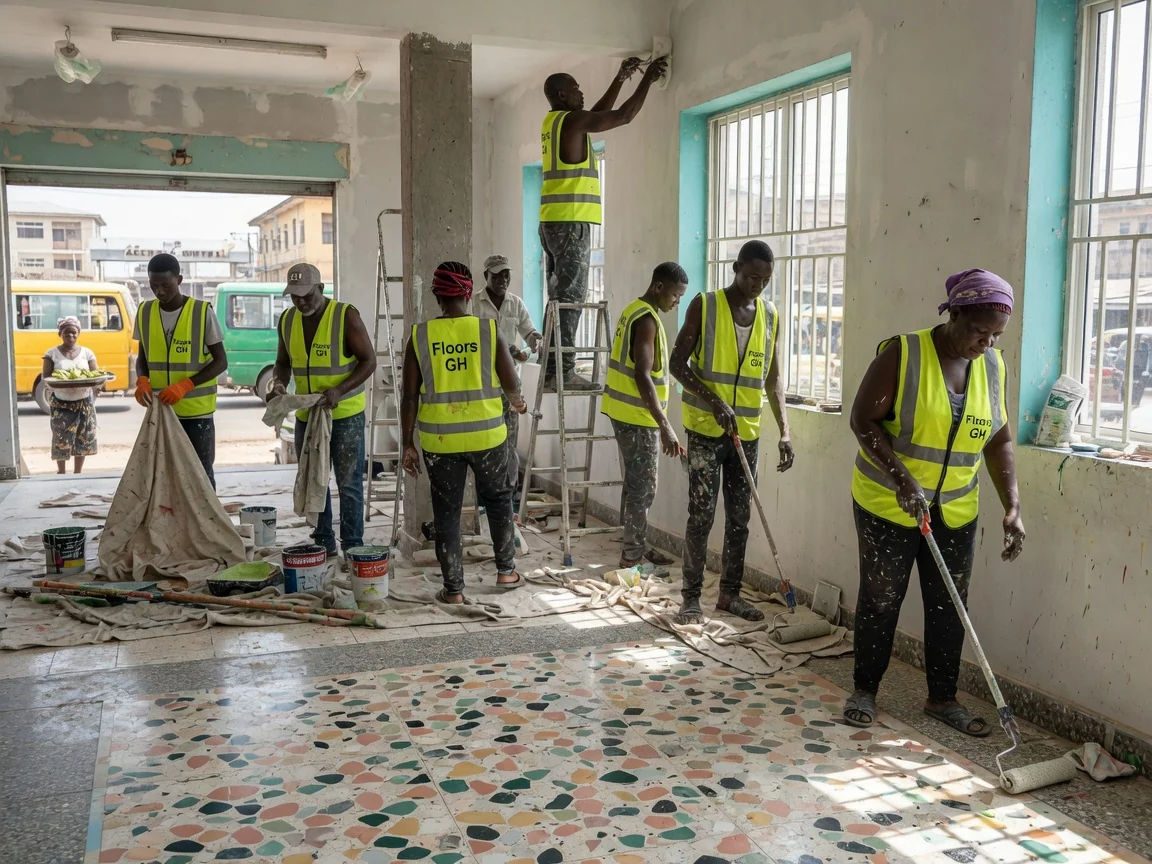
- Substrate preparation & flatness verification — grind/shot-blast to a sound keyed profile; fill cracks and voids; verify flatness to ASTM E1155.
- Aggregate, divider strip & pattern approval — workshop test panels at the agreed density; divider strips set to the NTMA panel layout and levelled to final height.
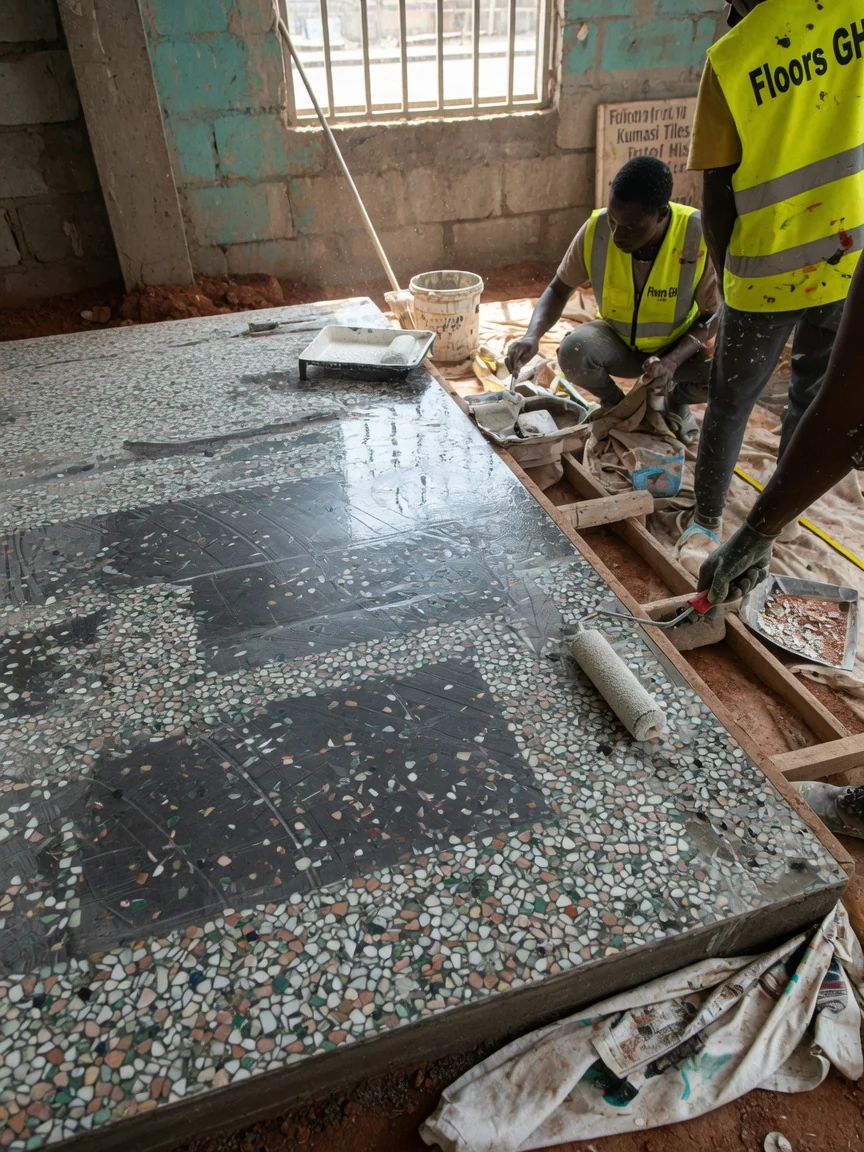
- Matrix mix & field pour — cementitious or epoxy matrix to NTMA proportioning, poured field by field within the divider grid; vibrated to minimise voids.
- Cure, diamond grind & progressive polish — cross-directional diamond grinding from coarse to fine, densifier, polish to the specified gloss, and seal.
Comparing Terrazzo Against Other Premium Floors for Ghana
| System | Best for | Lifespan | Renewable in place |
|---|---|---|---|
| Cementitious terrazzo | Large institutional fields, heritage matching | 40+ yrs | Yes — re-grind & re-polish |
| Epoxy terrazzo | Commercial, retail flagships, tight thickness budget | 30+ yrs | Yes — re-grind & re-polish |
| Marble | Banking/embassy lobbies, ceremonial spaces | Decades | Honing only — not re-poured |
| Polished concrete | Showrooms, zoned back-of-house | 20+ yrs | Yes — re-polish |
What Affects the Cost
- The matrix specified (cementitious vs epoxy) and the topping thickness
- Aggregate specification — standard marble chip through bespoke mother-of-pearl, glass cullet, or regional stone
- Divider-strip material (brass, zinc, aluminium) and pattern density
- Finish grit — utility through institutional through mirror gloss
- Substrate condition and any flatness or moisture remediation required
Every quote follows a site survey and substrate assessment — no fixed rate is given before the slab is checked.
Applications Across Ghana
- Hotel ballroom and lobby fields where the aggregate composition carries the brand identity — Airport City, Cantonments
- Museum, gallery, and cultural-institution atriums on the Ridge heritage axis
- Corporate headquarters and ministerial reception courts in East Legon and Ridge
- Airport, transit-hub, and government public floors with high-occupancy, long-cycle durability briefs
- Heritage terrazzo restoration in Cape Coast and Accra institutional buildings, and premium commissions across Kumasi and Takoradi
Areas We Serve
Floors GH installs decorative terrazzo across Airport Residential, Cantonments, East Legon, and Ridge in Greater Accra — plus Kumasi, Cape Coast, and Takoradi.
Related Services
- Marble Installation — book-matched natural stone for institutional lobbies
- Polished Concrete — for zoned cultural and back-of-house surfaces
- Self-Levelling Compound — substrate preparation before a terrazzo pour
- Heritage Parquet Restoration — conservation of original heritage interiors
Frequently Asked Questions
What is the difference between cementitious and epoxy terrazzo? Cementitious (Portland-cement matrix) terrazzo is the traditional, thicker bonded or sand-cushion system suited to large institutional fields and heritage matching; epoxy (resin-matrix) terrazzo is a thinner, faster-curing, lower-permeability system with brighter aggregate clarity and a wider colour range. Both are installed to NTMA methods over a properly prepared substrate.
Why does terrazzo crack, and how is it prevented? Terrazzo cracks when the substrate moves and the topping has no controlled break-line. Prevention is divider strips set to the NTMA-recommended panel layout — which localise shrinkage and substrate movement at the strip rather than across the field — over a sound, flat, properly prepared slab.
How durable is a terrazzo floor in a high-traffic public space? A correctly installed terrazzo floor lasts decades in high-occupancy institutional service; abrasion resistance is verified to ASTM C779, and the surface is renewable by re-grinding and re-polishing rather than replacement.
How much does decorative terrazzo cost? It is quoted on survey — cost varies with the matrix, aggregate specification, divider material, finish grit, area, and substrate condition. We never give a fixed rate before surveying the slab; request a site survey.